The Cave Economy
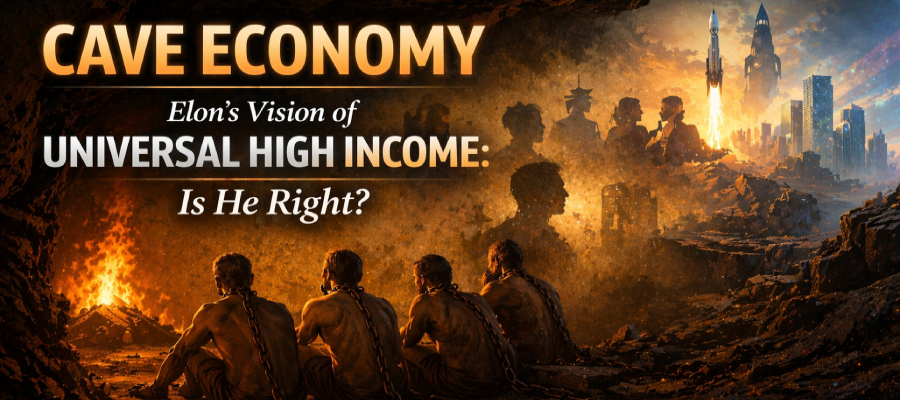
The social media response to Elon Musk’s recent statement on Universal High Income (not Universal Basic Income) has been revealing. Not because the criticism is particularly sophisticated, but because of how alarmingly unsophisticated it is. Accusations of hypocrisy, comparisons to anything from welfare to communism, and declarations of incoherence have flooded the feed from people who, without realizing it, are demonstrating the very problem Musk is trying to solve. Before dismissing a position or creating yet another unnecessary division, it is worth understanding it. That step appears to have been skipped entirely. We are at an interesting point. I call it a “Cave Economy.”
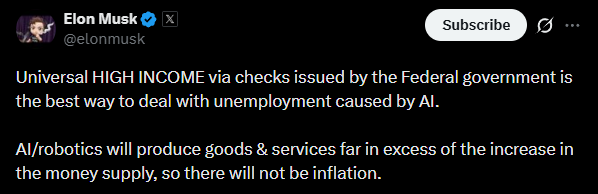
Musk’s statement was direct: “Universal HIGH INCOME via checks issued by the Federal government is the best way to deal with unemployment caused by AI. AI/robotics will produce goods and services far in excess of the increase in the money supply, so there will not be inflation.” Of course, critics immediately reached for the familiar playbook. This sounds expensive. This sounds like government overreach. We tried this during COVID. This sounds like something that will cause inflation. Some even called it welfare, socialism, or communism. It will create a nation of bums. Chaos without purpose. My favorite one was “If Al takes away all the jobs, who will buy the products that Al will produce?“
Each objection shared a fundamental flaw: they all applied the logic of a labor-coupled economy to a labor-decoupled one. That is a mistake founded in Epistemic Rigidity; in this instance, it’s the tendency to defend the only framework one has ever known, even as its foundational premises erode. I will just be blunt: it’s best not to evaluate a future economic model using the assumptions of the current one, because that’s not an analysis. If anything, that is the intellectual equivalent of calling electricity “witchcraft” because it does not behave like fire. Better yet, it is 1928 trying to explain 2028. And yet, somehow, even that doesn’t say enough.
A little economic and historical literacy goes a long way here. To understand why Musk’s position is absolutely coherent, it is necessary to understand what the current economic model actually assumes, and what it does not. The economy most people know runs on a foundational premise: human labor is the scarce input that drives value. You earn because you produce. Prices exist because resources are finite. And more to the point, employment is how wealth gets distributed across a population. This is how the system was designed, and it made perfect sense… so long as human hands ran the machine.
Now, for most of recorded economic history, that was the reality. Labor was scarce, production was limited by human capacity, and the relationship between work and income was the primary mechanism for distributing purchasing power. Every major economic framework, from classical to Keynesian to monetarist, was built on some version of this assumption. And yes, when critics say government spending causes inflation, within this model, they are absolutely correct. Excess money chasing limited goods drives prices up. That is basic supply and demand, and it has been validated repeatedly throughout history. That is not in dispute.
That, however, is precisely the model that is going away. What seems to be hard for so many to wrap their heads around is that this old model is being dismantled in real time. This means that all of those previous assumptions go out the window along with it. Artificial intelligence and robotics are the beginning of a structural decoupling of human labor from economic output. I know it’s hard to imagine, but when machines can produce goods and services at scale without proportional human input, the foundational assumption of the current model begins to implode. This results in a fundamental shift in the way the world distributes everything.
For example, scarcity, as a pricing mechanism, no longer applies when abundance becomes the output of automated systems. Moreover, employment, as a distribution mechanism, becomes entirely inadequate when the engine no longer requires human hands to operate. That doesn’t mean we should abandon progress; it means that we should advance the system by altering the underlying assumption.
Understand that this is not speculation about a distant future. What everyone needs to realize is that this is a description of a transition already underway, accelerating rapidly, and carrying consequences that existing economic frameworks were never designed to address. If anything, this is the regime shift, and frankly, it is the concept that critics are missing entirely.
As for welfare, socialism, or communism, the comparison to existing assistance programs misses the structural point entirely. Even the motives related to such classifications are about to shift. For example, current systems were designed to supplement labor income within a labor-coupled economy. Universal High Income in a post-labor economy becomes a distribution mechanism for automated abundance.
Think of it as a return on an investment you are already making. Every AI subscription, every platform you access, every tool you pay for is fueling the system that will generate the abundance later. Universal High Income is not a handout. It is more like a dividend. Many of you are already shareholders. You just have not received your distribution yet. But either way, pre-judging Universal High Income by the failures of welfare is like pre-judging the stock market by the limitations of a savings account. It is logically incoherent.
Different Models for Different Times
I should clarify that Elon is not proposing a utopia or a nanny state. It is merely a different system. Let’s think about this. Do you want to go back to trading tulips or beads? Probably not. Our dollar has lost over 97% of its buying power. Do you want to keep going down that road to the crash? Probably not. Something needs to change, and we all know it. Every year we defended or propped up the system, it took more from us. There isn’t much left to give at this point. The entire economic model is dying. But it is a Ponzi scheme anyway, siphoning the fruits of your labor into someone else’s pocket while you argue about whether any alternative is too radical. Who benefits from avoiding the shift?
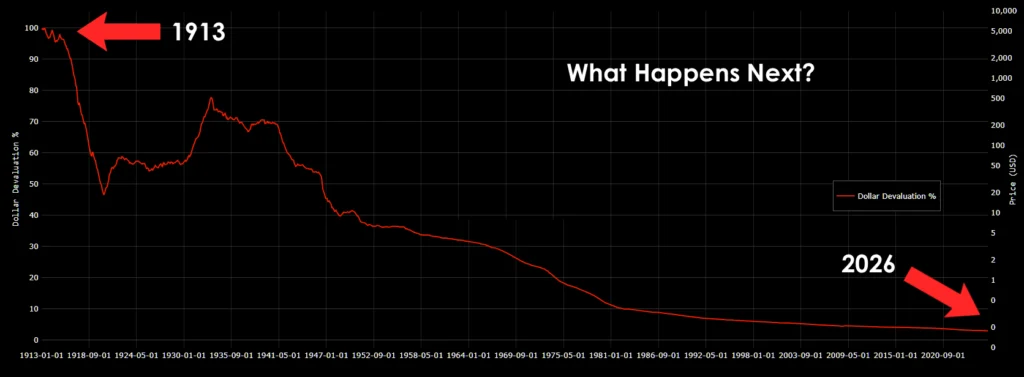
I probably don’t have to sell you on how bad our economic situation is. You feel it every time you go to a store or pay your bills. It’s unsustainable, and the ramifications are profound. The question is: Do you really want to continue on to its inevitable conclusion, or do you want something better while we still have a chance? I share this only to demonstrate three elements: 1) there was a time when our currency was strong, 2) we live in a time when the dollar is almost dead, and 3) it is probably a good idea to prepare for that funeral.
I need to make something clear. Several rebuttal posts spoke of Elon’s supposed “180” on government spending. Well, there was no 180. As previously stated, Musk’s earlier position, that inflation and excessive government spending threaten economic stability, was correct within the current model. However, his position that AI-driven abundance creates the conditions for a Universal High Income without proportional inflation is also correct within the incoming model. These are not contradictory statements. They are accurate descriptions of two very different economic systems.
One is a system of the past. The other is a system of the future. We just happen to be at the beginning of the middle, the transition between the two. The hard question is not whether the shift occurs, but how we manage the interval between models. Calling his statements a contradiction is like criticizing someone for driving differently on ice in the dead of winter than on dry pavement in the dead of summer. The driver has not changed. The operating environment has. We just find ourselves at the beginning of Spring. The criticisms only make sense if you assume the environment is static, and that assumption is precisely what is changing around us.
Let’s focus on Musk’s inflation argument for a second, because it is where critics concentrate most of their fire. We are already in a highly inflated situation. So, it makes sense that people are sensitive to it. Indeed, nobody with any sense of economic literacy and morality likes the outcomes of high inflation. Rightfully so. But that is why I am so confused about why people are trying so hard to save it.
We are talking about a time when labor and currency are no longer attached, and where humans are not the driver of output. In that environment, supply grows significantly faster than the money supply needs to. That leads to DEflationary pressure, not inflation, and that becomes the structural risk.
Oddly enough, Musk stated this plainly in his own words, and yet the criticism continues as though he said nothing at all. This is to say that his post had two parts. Everyone seems to focus only on the first part. Or maybe it just demonstrates the lack of economic literacy by those barking about it anyway.
For many, fear derives from the unknown or discomfort. Clearly, their criticisms are not disagreement based on analysis. They must be rejections based on fear and discomfort. I say that because if it were based on analysis, then timing likely would have been the focus. It seems to me that the hard part is deciding WHEN to pull the trigger.
However, I think the distinction matters enormously here because the transition between these two models is neither automatic nor painless. History is consistent on this point. Shifts between economic regimes, from agrarian to industrial, from industrial to information-based, are rarely smooth. They cause disruption and displacement, and, in the absence of managed transition mechanisms, crashes. Anyone with any historical understanding will know this. Anyone with a heart would want to avoid it. Yet we must come to terms with the fact that the crash is probably not far off, so a shift is inevitable. Just look at the following charts, and again, ask yourself, “What comes next?”
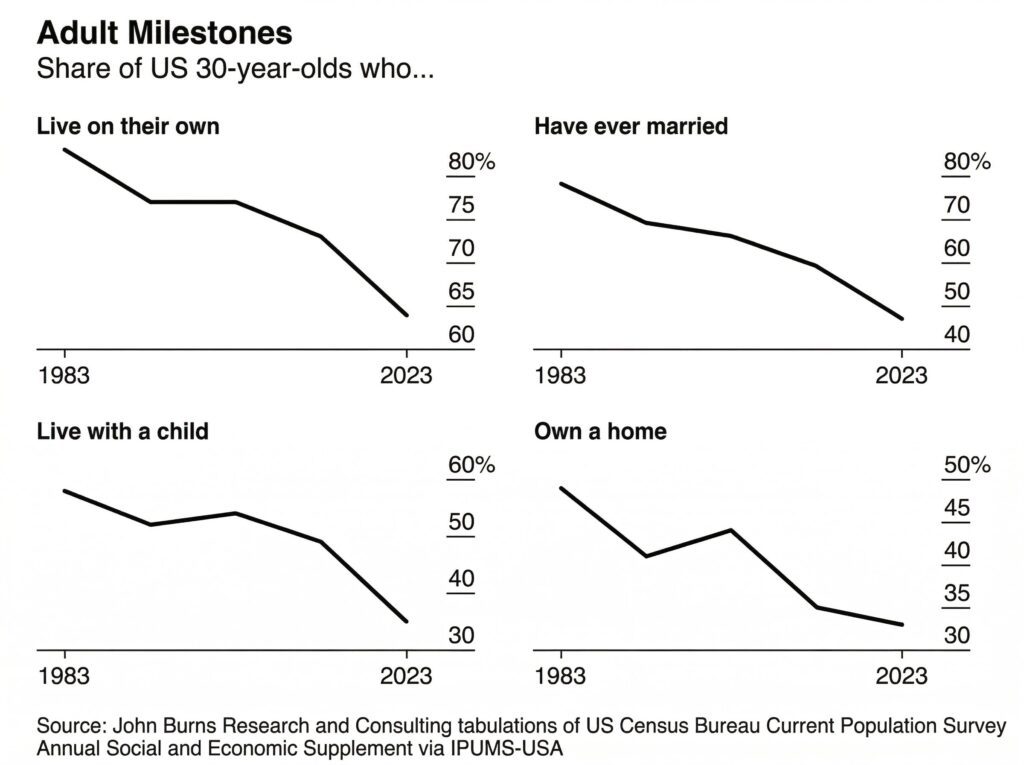
The people currently attacking UHI as fiscally irresponsible are, without intending to, arguing for the unmanaged version of this inevitable transition. They are demanding that we enter a new economic era with the tools of the old one, and they are calling that conservatism. Well, that’s not conservatism at all. It’s a demand for an unnecessary crash. They might as well suggest we pay for goods with tulips again. Moreover, I would argue that the current system is working against them, and there isn’t much left to conserve anyway.
It seems to me that there are essentially three positions available right now. The first is to acknowledge that a fundamental restructuring is occurring and to generate transition mechanisms (and related ideas) that distribute the benefits of automated abundance while maintaining social stability (as soon as possible). The second position is to insist on economic orthodoxy built for a world that is rapidly disappearing, and to treat any deviation from it as reckless. The third position is to acknowledge your knowledge gaps, admit to the fear, and just hold on for the ride anyway.
The first group is generating solutions for this transition (like Musk). The second group, without realizing it, is generating the conditions for the catastrophe they say they want to avoid. Of course, the third group will have some great stories to tell their grandchildren and will be amazed during the entire ride.
The thing to keep in mind is that the change is coming regardless of which position anyone holds. The only question is whether we arrive at the other side intact. My advice is to avoid resisting change simply because the mechanics of it are confusing. Try to understand that leaving something decrepit behind for something better is usually a good thing, even if that new thing is not perfect. For example, I like my outdated smartphone just fine. The telegraph or even the rotary dial were fun and all, but I’m not going back to either.
The Allegory of the Cave
Of course, the resistance you’re seeing has a name. Plato described it over two thousand years ago. In the Allegory of the Cave, prisoners chained underground mistake shadows on a wall for reality. When one prisoner escapes and returns to describe the actual world outside, the others don’t thank him. They attack him. The shadows are all they know and all they care about. The shadows are comfortable. Their eyes and their mind are adjusted. The idea of leaving the cave is scary. Anyone suggesting they leave becomes their enemy.
It gets worse, though. The descriptions of everything outside of the cave don’t get evaluated on their merits. The first-hand accounts are completely ignored. Everything about the outside world simply gets rejected because it threatens the only framework the prisoners have ever trusted.
Well, what is unfolding on social media in response to the UHI discussion is not an economic debate. It is Plato’s Cave, live and in real time. The frameworks being used to evaluate a post-labor economy were built inside a labor economy. They simply refuse to see outside it. And the man standing at the entrance, describing what he sees, is being accused of incoherence by the very people who have never left the wall.
Nonetheless, the fact remains. If employment can no longer serve as the distribution mechanism, we either need something else or we do away with that new system entirely. Well, trashing the future seems irresponsible at this point. The irony is that if half the energy spent badmouthing Musk were put into solving models, we would already have this thing solved. And sure, it may not be perfect, but so far, Musk is the only one offering up a viable solution rooted in the model that will be.
The Bigger Purpose
There is another point that deserves some honest attention. Part of the visceral resistance to Universal High Income is rooted in something deeper than economics. For most people, employment is not merely a financial mechanism. It is identity. And for some reason, they have confused their job with their purpose. For many, their job is how they answer the question of what they do with their life. That hurts my heart that so many find themselves in that boat.
The point is that the idea that income might be decoupled from employment does not just challenge an economic model; it also challenges the very notion of employment. Of course, this challenges the idea of self. And this creates an emotional problem, but emotion drives bias. That bias is evident when you simply scroll.
So, for some, if a check arrives regardless of whether they work, then the question of who or what they are becomes unavoidable. That is a genuinely uncomfortable question for many to face because so many simply do not have that answer. In fact, in some families, that quest was flat-out discouraged, and being told it’s okay to explore it now creates cognitive dissonance. Discomfort can be a powerful driver of bias, and in this case, rejection, because it is strongly linked to feelings of unease, anxiety, or mental distress.
But discomfort is not an argument. I would be remiss not to mention that conflating employment with purpose is a mistake that long predates this debate, but I would also like to make this point abundantly clear. A job is what you do for money. Purpose is what you would do without it. If the coming economic transition feels threatening at the level of identity, that is probably worth examining, because it suggests that somewhere along the way, someone convinced you that your labor and your meaning were the same thing. Well, I can promise you that they are not.
Perhaps the question is, what will people do with their lives in this environment? Well, history answers that question quite clearly. Every time technology eliminated a category of labor, human creativity filled the space with something the previous generation could not have imagined. The agricultural worker became the factory worker. The factory worker became the knowledge worker. The pattern is consistent, and it will continue. People do not stop creating when the machine takes the repetitive work. That’s when they start. Have a little faith in yourself.
A Better Question
It might be better to think of the coming shift as simply a transition. It’s a mechanism to allow us an opportunity to acclimate to something better just beyond the horizon. Your perception of this transition largely dictates whether it is “good” or “bad.” However, as previously mentioned, the transition remains either way. This isn’t going to go away.
For those who refuse or reject that change, they will remain in the cave, fiercely advocating for an economic model that has robbed them, taken food from their tables, and destroyed their dreams. For the people willing to look past the cave wall, it is an opening. It is a chance at a better future. It is an opportunity to try something new, with the potential to finally pursue what truly matters to them. If you have ever envied the wealthy’s ability to do that, your chance may soon be at your door.
There is one final point worth mentioning here. Musk has offered a solution, not the solution. In fact, he called it the best solution (right now), but it’s not the only solution. Other models will be proposed at some point soon. If we evaluate those based on efficiency and merit, the best solution will surface.
So perhaps the question is, how exactly could this work? Well, I’ve seen several plans. Regardless of which we choose, we must understand that a managed transition requires downstream operational mechanisms. One grounded approach is to tax the incremental output of automated systems (robot productivity, AI-generated value) at the point of production rather than labor income. Revenue funds the high-income transfers. Incentives remain aligned because the tax falls on capital that would otherwise concentrate. That is probably the most responsible and straightforward approach until someone, or AI, comes up with a better plan.
But these are just initial ideas. If you don’t like it or if you have a better idea for managing the most significant economic transition in human history, then by all means, the floor is open. Serious proposals are welcome. However, just understand that reflexive rejection is not the same thing as an alternative to the status quo. Moreover, fear of the unknown is no excuse for stagnation and decline.
Of course, there are some extreme benefits to consider that even Elon has not yet clearly articulated. For example, regarding concerns about government overreach, the same principles apply. The very same mechanisms that make AI and robotics highly disruptive in private labor markets will also reduce the functional need for large government bureaucracies. Leaner, more efficient systems simply do not require the administrative infrastructure that labor-intensive governance does. Hence, the government, like every other institution impacted by these technologies, will be forced to adapt. If you ask me, that is not a threat to liberty. It is an argument for it.
Here’s a thought experiment for you. Across the country, tens of thousands of people are employed at the DMV. Each one of those jobs requires more of your tax money. Think about how much you dislike that department anyway. Now, what part of ANY of those jobs couldn’t already be handled by AI and robots more efficiently? Wouldn’t you like to save those tax dollars? That’s where we are heading.
Ironically, many of the loudest voices rejecting UHI are the same voices that have spent years condemning the revolving door of big government, predatory banking, and concentrated corporate power. Okay, but then why defend these now? That’s what the critics are doing. As mentioned, this system is going to crash. A crash creates chaos. Chaos consolidates power. Consolidated power creates oligarchs. You end up where you started if you stick with the old.
However, this new model significantly reduces those risks. These technologies are literally going to reduce that nonsense. They already are. So, if you are arguing against the transition, make sure you understand what you are arguing for. But I have a feeling that those who do not want that oppressive system to end are working overtime to spread messages of resistance. Just be careful whose talking points you adopt and why. You should also keep in mind that the cave might be comfortable, but comfort and safety are not the same thing.
In my opinion, what this moment requires most is downstream, systems-level thinking. In other words, spend less time thinking about what was, and more time thinking about what could be. Think about what a smaller government, open-sourced technology, and more autonomy could mean in your life. If that sounds too good to be true, then the current system has truly hurt you. It’s probably time to leave the cave.
Naturally, someone has to take the first step towards the exit. Musk (thankfully) appears to be the one taking it. Now, that is not blind deference to a billionaire. It is an acknowledgment of a simple reality: he is currently the only person on the planet who understands abundance at that scale, and the only one with both the capacity and the willingness to attempt to architect what comes next in light of the inevitability of our current trajectory. The other tech giants simply do not seem to have the same motives. Without a doubt, when it comes to abundance, I’m going to listen to the true expert.
Now, you do not have to agree with every detail to recognize that someone moving toward the exit before driving off the cliff is significantly more useful than anyone arguing in the backseat about shadows on a wall. The exit is open. The question is who walks toward the light first.
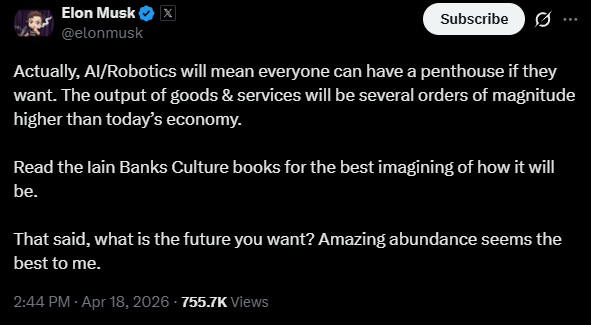
I’ll close with a simple idea. The coming economy will likely be significantly better than the one we are currently suffering through. You might even find a minute to relax. But oddly enough, even that scares some people. I saw a couple of posts discussing the potential drawbacks of excessive leisure in the age of AI and robotics. Well, I think I have the answer to that, too.
Aristotle said, “The end of labor is to gain leisure.” And then Thomas Hobbes said, “Leisure is the mother of philosophy.” If those are true, then we should appreciate that philosophy is the study of fundamental questions about existence, knowledge, reason, and value. Perhaps, we’ll finally be set free enough to discover what really matters to us. Interestingly, many experts suggest that philosophy and leadership science will be crucial in this new age. The timing couldn’t be better.
Sure, it will not be perfect. Nothing ever is. But the potential for “better” is definitely worth exploring, and that alone is reason enough to stop defending the cave.