So, the fireworks are over. The yard is littered with cardboard and plastic fragments. The flags are still up, the cookouts are winding down, and the phrase ‘land of the free‘ has been repeated enough times over the past few days to feel like something between a national anthem and a reflex. Don’t get me wrong. The sentiment was sincere. It always is. And that sincerity is part of what makes the honest conversation that follows absolutely necessary. America is now 250 years old, but I think an honest reflection on the occasion is warranted.
We need to be honest with ourselves. There is a significant difference between what America was designed to be and what America has actually become. That gap doesn’t diminish the founding. If anything, it makes the founding more important, because the founders anticipated exactly this kind of drift and left behind both the diagnostic tools to identify it and the remedies to correct it. The 250th anniversary was an appropriate moment to celebrate. The Monday after is an appropriate moment to think.
I’ll start by saying that we cannot support, love, defend, or exercise something we do not know. I have asked hundreds of people the same question, and I can count on one hand how many people have given the correct answer and still have fingers left over. “What is the vision of the United States?” If you cannot answer this question, you cannot strive for that destination.
I’ll give you a great example. Dr. Ron Paul touched on this argument in a piece published by the Ron Paul Institute for Peace and Prosperity ahead of the holiday, which received far less attention than it deserved. Paul observed that the government’s first claim on the earnings of every working American through mandatory withholding is not, in any philosophically coherent sense, compatible with natural rights. The withholding system does not ask for a portion of what has been earned. It claims a portion before the citizen receives it, positioning the government as the primary earner and the citizen as the beneficiary of what remains. Perhaps that is why they have the audacity to call it ‘revenue.’
But one has to ponder how this happened. Where did the government get the power? Paul’s broader argument is that the relationship between the American government and American rights has quietly inverted over time: the government no longer protects rights it recognizes as natural and pre-political. Instead, it grants privileges and reserves the authority to revoke, regulate, or redefine them. That is not the republic the founders designed. What’s going on here, and how can we, in such an environment, lie to ourselves about being a free people?
The Data Behind the Declaration
“Land of the Free – Home of the Brave,” right? The United States ranks 15th on the Cato/Fraser Human Freedom Index, outside the global top ten by a margin that should produce more national conversation than it does. Economic freedom, as measured by the Heritage Foundation’s annual index, ranks the United States 26th, the worst position ever recorded in the index’s history. Press freedom, as measured by Reporters Without Borders, currently stands at 64th globally. I could go on, but you probably get the point. Understand that these are not the rankings of the freest nation on earth. They are the rankings of a nation that was designed to be the freest on earth and has been gradually diverging from that design for long enough that the divergence now appears in the data with considerable clarity.
Of course, the response to these numbers from those invested in the uncomplicated version of American exceptionalism is typically one of three things: that the indices are flawed, that other countries are worse, or that the rankings do not capture the full picture. Each of these responses may contain partial truth, but none of them constitutes an argument that the rankings are wrong in a direction that flatters the United States. The methodological objections are available to anyone who wishes to examine them, and after examination, the rankings hold. The ‘other countries are worse’ argument is nothing more than a defense. Frankly, I think it confirms the problem while declining to address it. And by the way, the ‘full picture’ argument requires producing a fuller picture, not simply asserting that one exists.
The fuller picture, as it happens, makes the argument more pointed. All we have to do is look at our legal architecture. All laws repugnant to the Constitution are supposed to be void. That principle, established in Marbury v. Madison and rooted in the supremacy clause, is among the foundational mechanisms of constitutional governance. Yet there are more laws on the books than any single institution can count, and a consistent originalist analysis suggests that somewhere between 15 and 30 percent of federal statutes and regulations carry at least a partial constitutional defect.
Of course, that figure doesn’t include state, county, or local law, which substantially compounds the estimate and receives far less constitutional scrutiny than federal law. This is mainly because most unconstitutional local ordinances are never challenged by anyone with the standing, resources, and will to pursue them. Where are the ‘brave’ challenging such violations?
The Bill of Rights in Practice
The Bill of Rights was written as a list of prohibitions directed at the government. Each was specific and grounded in documented abuses the founders had either experienced personally or studied in detail. The distinction between what those prohibitions say and what they currently produce in practice is one of the more uncomfortable conversations in American civic life. Of course, this is precisely why such discussions are so rarely held over the holiday weekend. Do we want to be right, or do we need to be accurate?
- The First Amendment protects freedom of speech, religion, the press, assembly, and petition. Each of those protections faces systematic real-world infringement through a combination of regulatory pressure, platform coercion with governmental involvement, licensing requirements that function as prior restraint, and enforcement mechanisms that apply disparately across viewpoints.
- The Second Amendment protects the right to keep and bear arms. It is currently administered through a regulatory structure that the founders would not have recognized as compatible with the text.
- The Fourth Amendment protects against unreasonable searches and seizures and requires warrants supported by probable cause. Civil asset forfeiture, warrantless surveillance programs, and administrative searches have created entire categories of government intrusion that operate outside the warrant requirement that the amendment was written to enforce.
- The Fifth Amendment protects against self-incrimination and guarantees due process. The expansion of administrative proceedings, in which agencies investigate, adjudicate, and penalize without the procedural protections that due process was designed to require, represents a structural erosion that does not appear in most constitutional law textbooks as a crisis but functions as one in practice.
The pattern is not unique to any amendment. It is consistent across all ten, and the consistency is not coincidental. You need to understand that the founders anticipated it. In fact, they wrote extensively about the tendency of power to expand into every space that law or vigilance does not explicitly defend.
Of course, what they could not have anticipated is the degree to which the expansion would occur gradually enough to be normalized. It happened one step at a time. One regulatory addition at a time, one precedent at a time, until the cumulative result no longer resembles the original design and the people living within it have no direct memory of what it felt like in practice. It’s a good thing for those in power that their Federalist schools no longer emphasize such topics and that literacy rates continue to plummet. After all, that environment sure makes discovering such truths less likely, doesn’t it?
The Grievances We Filed and the Ones We Now Tolerate
The Declaration of Independence lists 27 specific grievances against King George III (also see Thomas Jefferson’s rough draft). They were listed as justifications for the most consequential political act the founders had yet undertaken. They were written to be specific enough that posterity could evaluate whether the abuses had recurred. Well, posterity can.
A careful reading of the original 27 grievances against the backdrop of current American governance demonstrates that a meaningful number of them, at minimum eight to twelve by a conservative structural analysis, describe patterns that are active today in form if not in identical expression. For example:
- The grievance concerning the erection of ‘a multitude of new offices’ and the sending of ‘swarms of officers to harass our people’ describes the expansion of the federal regulatory apparatus as accurately as it describes the colonial administration.
- The grievance concerning judges made dependent on the executive for tenure and compensation has a structural echo in administrative law judges who adjudicate within the same agencies whose rules they are asked to evaluate.
- The grievance concerning the combining with others to subject the people to a jurisdiction foreign to their constitution finds a contemporary parallel in international regulatory agreements that bind domestic policy without direct congressional consent on each specific provision.
- The grievance concerning the deprivation of trial by jury in many cases appears in the expansion of administrative proceedings in which agencies determine liability and impose penalties without a jury ever entering the room.
Again, I could go on, but the point is the founders objected to power that operates beyond consent and beyond reach. The mechanisms they described in 1776 are specific to the structural relationship between concentrated power and the people subject to it. That relationship does not change just because the concentrated power wears a democratic face or has an ‘R’ or ‘D’ behind it. It changes when the constraints designed to limit it are actively enforced rather than passively assumed, and I hate to say it, but a weekend of fireworks is not enforcement, acknowledgment, or remembrance when nearly half of the people don’t even know what they’re supposedly celebrating.
Still Worth Fighting For
Now, none of this is an argument that America has failed or that the republic is beyond recovery. America had a vision, and that vision is still worth pursuing. If anything, it is an argument that recovery requires an honest diagnosis, and that an honest diagnosis requires resisting the comfortable narrative that the work is finished, that the freedoms are secured, and that the birthday party was sufficient. The pursuit of the vision of this republic is not finished. It is entirely unfinished.
For those who can read, the Declaration itself contains the answer. The founders understood that rights unexercised are rights surrendered, that a citizenry that does not know what it possesses cannot defend what it possesses, and that the accumulation of unchallenged power by government is not a sign of government’s strength but of the citizenry’s inattention (and ignorance). They built the correction mechanism into the founding documents and then spent the rest of their lives arguing about whether the population was educated enough to use it. That argument has not been resolved. Oddly enough, after this particular weekend, it has become more urgent.
The honest retrospective on America’s 250th birthday is not the one that pretends the republic is exactly what it was designed to be. It is the one that acknowledges the distance between the design, the vision, and the current condition. Moreover, it names the mechanisms that produced that distance, and commits to the only correction the founders identified as reliable. They were not subtle about what that correction was, and they said so in terms that have not aged. Thankfully, that remedy is within your reach, and I know that because you’re reading this.
What Jefferson Actually Said
“If a nation expects to be ignorant and free, in a state of civilization, it expects what never was and never will be.”
Thomas Jefferson wrote those words in 1816, more than three decades after the Declaration and nearly as long after the Constitution. He had watched the republic take shape, had served as its third president, and had seen enough of its operation to understand what threatened it from within. The threat he identified was not a foreign adversary or a military force. It was the population’s ignorance. We cannot be ignorant if we want to govern ourselves. He was not being rhetorical. He was being precise, literal, and emphatic.
Of course, he was equally precise about the remedy. In a letter that deserves considerably more circulation than it receives, Jefferson wrote:
“Preach, my dear Sir, a crusade against ignorance; establish and improve the law for educating the common people. Let our countrymen know that the people alone can protect us against these evils, and that the tax which will be paid for this purpose [Education] is not more than the thousandth part of what will be paid to kings, priests, and nobles who will rise up among us if we leave the people in ignorance.”
He would go on to say that this should be extended to whatever level one so chooses (including higher education), and he opened the University of Virginia to put his money where his mouth was. But let’s examine this in contrast. One can note the rise of a ruling class and the simultaneous decline of literacy and educational performance. That convergence is not coincidental. After all, one can note that criminal behavior and a lack of education go hand in hand. Of course, that connection runs through one of the most under-discussed mechanisms in American civic life: overcriminalization.
Today, an estimated 70 to 100 million Americans, roughly one in three adults, now carry an incarceration, conviction, or arrest record. That figure is the product of decades of legislative excess that has quietly expanded the definition of criminal conduct far beyond any reasonable boundary. Overcriminalization is the proliferation of laws and regulations that deem conduct illegal, frequently without requiring criminal intent, and frequently targeting behavior that produces no identifiable victim. There’s that ‘Land of the Free’ thing again!
Of course, an illiterate population cannot read the laws that govern it, nor can it effectively navigate the system that pulls it in. Moreover, isn’t it interesting that non-compliance removes those from the discussion? After all, a criminalized population cannot fully participate in the civic life that is supposed to check the power accumulating above it. Neither outcome is accidental, and both serve the same interest.
Not that it matters, because when the volume of criminalized conduct is so vast that one in three adults carries a record, the aggregate effect on liberty begins to look less like a criminal justice system and more like a social control mechanism. This seems to be a challenge for the Fifth, Eighth, Tenth, and Fourteenth Amendments, if you ask me. ‘Land of the Free,’ though, right?
Much of the overcriminalization phenomenon has occurred at the federal level, criminalizing conduct with no meaningful connection to interstate commerce and that the founders would have left to state or local governance (per the Bill of Rights) entirely. The Commerce Clause has been stretched well beyond its original limits to justify federal criminal jurisdiction over inherently local conduct. I’ll just say that substantial portions of the overcriminalization apparatus are constitutionally suspect under a consistent reading of the text. But again, this has been normalized largely due to the populace’s ignorance.
Jefferson understood that ignorance is not simply the absence of information. It is literally the condition that makes every other form of political failure possible. A population that doesn’t know its rights cannot defend them. A population that doesn’t know its history cannot recognize the repeating patterns. A population that cannot read the documents that govern it cannot evaluate whether those documents are being honored. And finally, a population that doesn’t understand civics cannot navigate the legal framework to remedy the insult. So, isn’t it interesting that the ones tasked with conveying such information are also the ones who benefit from your not knowing?
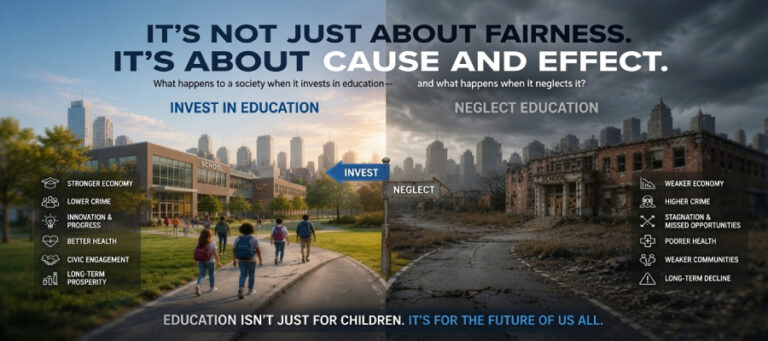
The investment in genuine education was not, in Jefferson’s view, a social program. It was the minimum maintenance cost of a functioning republic. But here’s the kicker. Education was not supposed to be controlled by the government, only funded by it. This is why I find it odd that private, magnet, homeschooling, and alternatives are deemed as a threat and go unfunded, when they continually outperform the state-sponsored indoctrination centers. I also find it both convenient and ironic that today, people are okay with paying for state-run indoctrination and failure centers, which ensure the preceding continues, but they’ve been conditioned to resist the potential remedies of higher private or conservative options. Yet, somehow, few can see how that position literally feeds the underlying problem.
Anyway, the gratitude for what was built is genuine and warranted. No doubt! The celebration deserved to happen. After all, it’s quite a milestone for us. However, what also deserves to happen now that the weekend is behind us is the kind of honest reckoning that a 250-year-old republic built on the principle of self-governance requires of the people doing the governing. We cannot support, love, defend, or exercise something we do not know. Jefferson said it first, and it’s probably one of the more important things he ever said. For us, it should be a reminder that the work is not yet finished.
I love my country. I don’t want to see her fall. If you’ve made it this far, I’m guessing you don’t want to see that either. So, moving forward, my advice is to learn and teach as though the republic depends on it… because it truly does!