Let’s talk about the dangers of AI Monitoring. Artificial intelligence is increasingly being deployed to address organizational security risks. AI systems now monitor networks, scan communications, flag anomalies, score behaviors, and populate dashboards that promise real-time visibility. The prevailing assumption is that more monitoring produces greater awareness, which in turn leads to increased security. While seemingly logical, I would argue that the assumption is increasingly wrong.
The problem is that AI-driven monitoring systems often increase perceived control while simultaneously reducing actual situational awareness. Organizations feel safer because more data is being observed and summarized. In practice, they become blind to entire categories of risk that fall outside the system’s view, interpretation, or escalation. The result is not a failure of technology but a failure of judgment, driven by misplaced trust in automation.
I’ll just be blunt here and say that security does not fail when systems stop working. It fails when people stop thinking. Frankly, this is likely going to be an increasing problem moving forward.
AI monitoring systems (necessarily) operate within predefined parameters. They detect what they are trained to detect, prioritize what they are configured to value, and ignore what cannot be formalized. But that’s exactly the problem. This creates a bounded view of reality that is easily mistaken for comprehensive oversight. Leaders and security teams begin to equate dashboard visibility with organizational awareness, even though dashboards reflect only what the system has rendered legible.
The blind spot is that as monitoring expands, informal sensing contracts. Employees become less likely to raise concerns that do not trigger alerts. Managers often defer to system outputs rather than relying on human judgment. Worst of all, anomalies that do not fit predefined categories are dismissed rather than explored. Over time, risk migrates away from monitored channels into unobserved spaces such as assumptions, decision shortcuts, informal communication, and cultural norms.
Automation bias plays a central role in this process. When AI systems are introduced as authoritative tools, human operators tend to overweight their outputs and underweight their own uncertainty. Alerts that fire are treated as important. Signals that do not fire are treated as the absence of risk. This creates a dangerous asymmetry where silence is interpreted as safety. Of course, if humans are trained to see only certain things, they too might simply dismiss or overlook various issues.
Alert fatigue only compounds the problem. As AI systems generate increasing volumes of notifications, human attention becomes selective and routinized. Warnings are triaged mechanically. Escalation thresholds rise. The downstream effect is that the organization becomes slower to respond, precisely as it becomes more instrumented. The mere presence of monitoring infrastructure creates confidence that someone, or something, is watching. In reality, no one is thinking. You can prove this to yourself by simply thinking about your antivirus software and how you navigate, knowing it’s there.
Perhaps the most subtle (but profound) effect of AI monitoring is its impact on dissent. When organizations rely heavily on automated scoring and classification, challenging system outputs become socially and professionally risky. Questioning an AI assessment is framed as emotional, subjective, or resistant to progress. Over time, disagreement declines, but not because the system is correct, but because contesting it feels illegitimate.
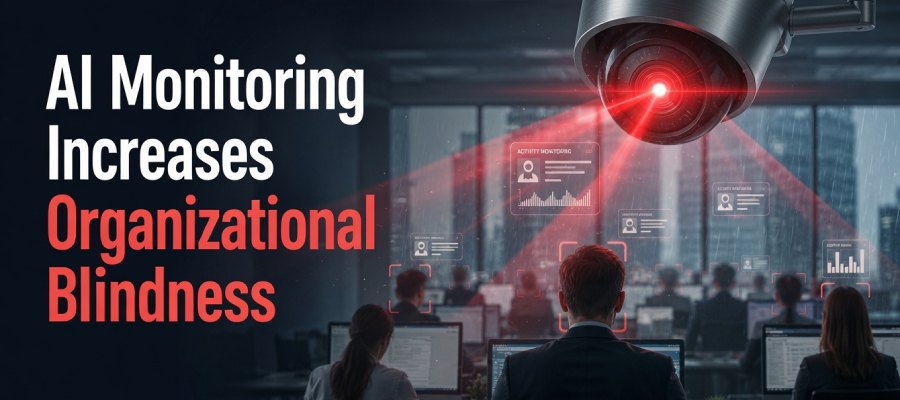
This is how monitoring increases blindness. The organization sees more data but understands less. It tracks activity but loses context. It detects deviations but misses meaning. The security posture appears strong, while decision quality quietly erodes.
The core failure is epistemic. AI monitoring changes how organizations define knowledge, authority, and risk. When awareness is entirely delegated to systems without parallel reinforcement of human judgment, security becomes performative rather than real. Ultimately, this means risk increases in areas that are not being monitored, creating strategic vulnerabilities.
Now, I want to make this point abundantly clear. AI is amazing, so I am not suggesting that the solution is less AI. What I am saying is that disciplined restraint wins the day. Monitoring systems must be treated as partial instruments, not truth engines. Human review must be explicit, incentivized, and protected. I would also suggest that Contrastive Inquiry should be incorporated into security oversight. Moreover, I think unstructured signals must be valued rather than dismissed.
Security depends on how accurately organizations interpret what they see and what they do not. In today’s world, blindness is not the absence of data. It’s usually the absence of judgment. Just ask any IT professional about how many employees will click on the bait emails they send out. I’m just saying that AI monitoring, when ungoverned, accelerates that condition.
If you enjoyed this article, you might also like: When AI Becomes Epistemic Gatekeeping