Education and the Survival of a Republic
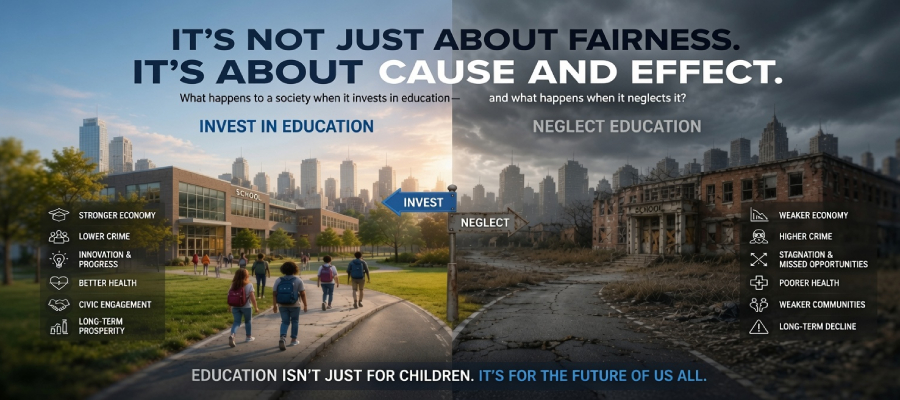
The debate over whether individuals without children should contribute to the cost of education has been around for generations. Some argue that it is unfair to impose taxes on individuals who do not directly benefit from the system. Others argue that it is a civic duty that supports the common good. Unfortunately, the disagreement is framed as a matter of fairness, but that’s not what it should be focused on. Beneath supposed fairness lies a deeper issue: cause and effect. Contrastive Inquiry wins again! What happens to a society when it invests in education, and what happens when it neglects it?
As a cognitive behavior scientist, I approach this issue from a behavioral and structural perspective. I think you probably should as well. Education is not charity for parents. It is infrastructure for society itself. As our Founders made clear, a functioning Republic cannot survive without an educated population, because education is the foundation that sustains order, opportunity, and liberty.
Cause and Effect: Why Education Matters
I want to start by making this point clear. A lot of people get upset about paying out benefits to those in poverty. Well, the data is consistent across time and geography. Populations with lower levels of education consume more benefits, fall into deeper poverty, and commit more crime. So, on the one hand, you can pay for education, or you can pay for the aftermath of not doing so. The correlation is not incidental. Education opens the door to opportunity, equips individuals with the tools to make informed decisions, and builds the skills necessary to participate in a complex and evolving society. A lack of education leaves people vulnerable to manipulation, dependent on others, and more likely to destabilize their communities.
Consider a personal example. You work hard to earn what you have. Do you want it stolen? If it is stolen, who recovers it? Who investigates the crime, prosecutes the case, and oversees the punishment? Every part of that process requires educated people. Law enforcement, courts, and corrections all rely on literacy, training, and specialized knowledge to perform their duties effectively. Even the roads that police cars drive on were designed and built by educated engineers. Remove education, and the systems you depend on collapse, leaving you defenseless.
The Firearm Argument
Some will argue that one can bypass all of this by owning a firearm and defending oneself. At first glance, that sounds decisive, but it does not hold up under scrutiny. Buying, owning, and using a firearm requires education at every stage. You must know how to navigate background checks, understand the laws governing purchase and use, and recognize the liability issues that arise when using it. You must also learn to evaluate the weapon’s quality, select the right ammunition, and train in its safe and effective use. All of these tasks require literacy, reasoning, and exposure to systems that only exist because of education.
Even the firearm itself depends on education. Engineers design it, manufacturers assemble it, and regulators ensure that quality standards are met. Ammunition is produced under strict processes that demand technical expertise. Courts determine whether an act of self-defense was lawful, and those courts depend on literate judges, trained clerks, and enforceable laws. Some might argue for “private defense.” The reality is that even so-called private defense still relies on the foundation provided by education. Private defense is defined by law, and you have to be able to read and understand that law. So, without that foundation, such measures are not a substitute for order. They are a recipe for chaos.
The World Without Education
Now imagine a society without an education system. People are left to fend for themselves with no structured foundation of knowledge. Imagine, further, that you were never educated. Would you know how to read a contract, understand an agreement, or recognize when someone was trying to take advantage of you? Would you even be able to participate in this very discussion?
The answer is almost certainly no. Without literacy, math, and reasoning, free exchange collapses. Contracts lose their meaning, markets fail, and individuals are unable to defend their rights. I need you to understand that ignorance creates a vacuum that is quickly filled by exploitation and crime. A society that abandons education does not become freer. It becomes unstable, chaotic, and dangerous, and an entire planet filled with history (which requires reading) demonstrates that point over and over again.
Jefferson’s Warning
And if you don’t like my argument, perhaps you’ll listen to one of our Founders. Thomas Jefferson understood this reality quite well. In a letter he wrote:
“Preach, my dear Sir, a crusade against ignorance; establish and improve the law for educating the common people. Let our countrymen know that the people alone can protect us against these evils, and that the tax which will be paid for this purpose [education] is not more than the thousandth part of what will be paid to kings, priests, and nobles who will rise up among us if we leave the people in ignorance.”
Jefferson’s words capture the essential point. The tax for education is minimal compared to the cost of ignorance. Without education, opportunists, elites, and demagogues rise to exploit the unprepared. Liberty cannot survive in an ignorant society. And I know what you’re thinking right now. “But the education system sucks, and it’s pumping out a bunch of idiots.” That’s true in certain cases, but that’s not an education issue; that’s a government agenda and curriculum issue. If you look into it, only public and state institutions are dealing with that issue.
Imperfect Systems, Real Responsibilities
Recognizing the necessity of education is not the same as claiming the current system is flawless. Education can, in fact, be extremely important, while also admitting that it is currently being handled entirely wrong. Public education today is expensive, often biased, and in many ways broken. It requires significant reform. I’m 100% with you on that. And other models may prove more effective in the future, and I welcome the development of alternatives.
Now, some would rightly argue that alternatives already exist, and I concur. In fact, I have often advocated for educational choice, whether through private schools, magnet programs, or vouchers, and I continue to believe that innovation and competition can improve outcomes. We can start down that road anytime you like, and some areas are already doing so. I commend the effort.
But none of that changes the core reality that education itself is indispensable. What is clear is that no education, or pseudo-education that leaves people unprepared, is disastrous for individuals and for society as a whole. You are literally watching that happen before your eyes. The form may be debated, but the function cannot be ignored. That said, and until those alternatives exist, we must work with the system we have.
But the irony is that bias is skewing the view of many in this debate. You have the ability to reason. You have the ability to read. You know some of the history. You understand at least some governmental issues. And more importantly, you have the ability to compare and contrast with reason. Where did you get those skills? Surely you can admit that you have benefited from education.
If so, then rejecting it outright while benefiting from its outcomes is inconsistent and hypocritical. On average, a K-12 education in the United States costs about $203,000 per student. Every adult who can read, write, perform basic math, and engage in critical reasoning has already drawn on that investment. To deny the system while standing on its foundation is to deny reality itself. And when you think about turning your back on the college students, who are simply doing what they were told to by almost every adult in their lives, it’s a whole different problem.
Integrity and the Republic
The core issue is not taxation versus preference; it is the underlying issue is survival. Education is the bedrock of a functioning Republic. Without it, liberty collapses under the weight of ignorance, crime, and exploitation.
Integrity demands consistency. If one insists that public education is theft, then intellectual honesty requires repayment of the benefits already received. Few are willing to do so. The consistent path is to recognize that, while the current system has flaws, the responsibility to educate is essential. It is not about whether one has children. It is about whether society has a future. Education is not optional infrastructure. It is the insurance policy of liberty itself.