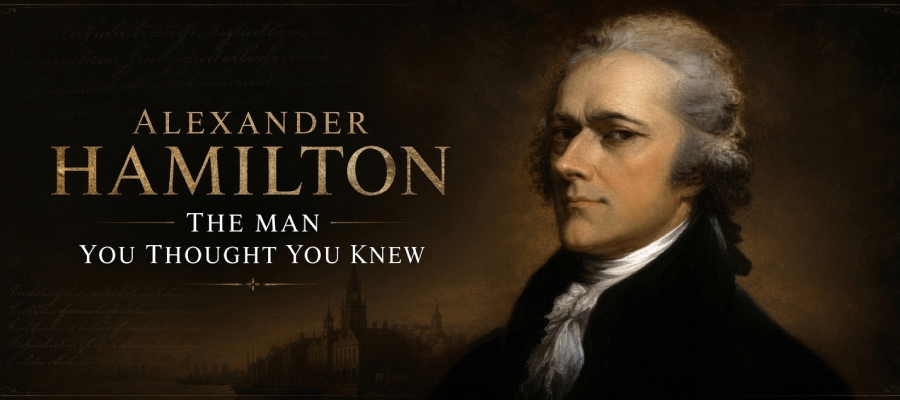
There is a very good chance that your education (and media) holds that Alexander Hamilton was a hero of the founding generation. For the Federalists who shared his vision, he was exactly that: the architect of American finance, the mind behind a functioning treasury, the man who gave a fragile confederation credit and standing. That version of Hamilton has been told often and told well, to the point that many today actually believe it to be the whole truth.
However, there is another version, built from the same documents, that receives far less attention. It is the version that guys like Thomas Jefferson spent much of their lives warning against: a man who arrived at the Constitutional Convention proposing something close to an elected monarchy, who built a financial system that enriched a narrow class of speculators at the expense of the soldiers and citizens who had actually won the war, and whose instincts, at nearly every turn, ran toward Britain and away from the republican experiment he is now remembered for defending. Jefferson said it plainly in 1816, writing to John Taylor that banking establishments were more dangerous than standing armies. He did not arrive at that conclusion in the abstract. He arrived at it, watching Hamilton work.
Now, this is not an argument that Hamilton was a traitor in the legal sense or that his intentions were criminal. Instead, it is an argument that the story deserves a second telling, using Hamilton’s own words and the record he left behind. That story paints the picture of someone rather shady. However, readers should consider the following and weigh the record for themselves. Also understand that what follows is not a verdict. It is simply a set of facts and questions built from the documentary record, offered for the reader to weigh and pursue further.
Important Pre-Context
There are a couple of things I would like you to keep in mind as you read this. First, our founding is sometimes called a ‘great compromise.’ In fact, the Massachusetts Compromise became the model for the other states. It proposed ratification while suggesting amendments, leading to the adoption of the Bill of Rights. The Bill of Rights appeased the Anti-Federalists’ demands for personal freedoms, while Federalists got much of what they wanted in the Constitution. Put plainly, the Constitution established governmental power (Federalist), but the Bill of Rights protects individual liberties by limiting that governmental power (Anti-Federalist).
Second, one can note that many of the Federalist Founders are lifted up today as heroes by Federalist education. Their policies are celebrated accordingly. They are immortalized in both academia and cinema. At the same time, many of the Anti-Federalist Founders are now demonized or completely omitted from the stories. They are the ‘bad guys’ that our history must endure. This framing is no accident.
Convention Speech by Alexander Hamilton: The Nameless Monarchy
Hamilton’s ambitions for American government were on record before the Constitution existed. At the Constitutional Convention in June of 1787, he delivered a speech. History records that the speech was remembered by delegates as remarkable, even in a room full of remarkable men, proposing a president and a senate who would serve during good behavior.
The part you might not have been told was that he was advocating for life terms. He held up the British system as his model, arguing that the stability of the English constitution, crown and all, was what a durable American government required. Both the Virginia and New Jersey plans, the two major proposals already on the table, struck him as too weak to hold a nation together.
Indeed, the delegates were startled, and even sympathetic colleagues thought his idea was too much. Hamilton knew this. He said so himself, framing the speech as an expression of principle rather than a serious legislative proposal. But the content of that principle matters. A man does not accidentally propose an elected monarchy. He proposed it because it reflects what he believed government should look like when given a truly free hand, and Hamilton’s free hand pointed toward London, not toward the republican theory that men like Jefferson and Madison had spent years developing.
Thankfully, Hamilton lost that argument and accepted the Constitution that emerged. Of course, he also co-authored the majority of the Federalist Papers to secure ratification. He was a true Federalist, and the side he chose is telling. If anything, it provides insight into which side was closer to what he asked for. Rightfully so, the Convention speech remained a fixed point of suspicion for Jefferson and Madison for the rest of their political lives, and the record shows they had good reason to remember it.
Were you taught about the Anti-Federalist Papers?
The Ledger: Who Actually Profited
After the war, Alexander Hamilton saw his opportunity. Hamilton’s 1790 Report on Public Credit proposed that the federal government assume the states’ war debts and fund the existing national debt at full face value. The stated purpose was credibility: a government that honored its debts completely, rather than selectively, would establish the trust required to borrow cheaply in the future. Jefferson and Madison were fiercely opposed. Washington backed the plan, and after the compromise that placed the new capital on the Potomac, it passed.
The mechanics of who actually collected on that promise tell a less flattering story than the credibility argument alone suggests. By 1790, most of the original war bonds, issued to soldiers, farmers, and small merchants who had financed the Revolution through requisitions and paper promises, had already changed hands. Desperate for cash and doubtful the government would ever make good on them, the original holders had sold at steep discounts, in many cases ten or fifteen cents on the dollar, to speculators concentrated in New York and Philadelphia who could afford to wait.
When Hamilton’s plan paid those bonds at full value, the windfall went overwhelmingly to the speculators who held the paper at the moment of payment, not to the citizens who had earned it. However, that plan was known by a select few in advance. In fact, these men (with advanced knowledge of the plan), some of them sitting in Congress, raced letters and riders south to buy up bonds before the news reached the original holders. It was a devious scheme.
Shortly after, Alexander Hamilton got his bank. However, the Bank of the United States, chartered in 1791 and modeled directly on the Bank of England, compounded the problem. Moreover, roughly seventy percent of the bank’s stock ended up in foreign hands, predominantly British.
Conveniently, a full accounting of exactly which individuals held that stake has never been compiled. It remains one of the genuine, underexplored gaps in the financial record of the founding era. You can decide the motives. What is not in question is the shape of the outcome. You must understand the result was a financial system built by the Treasury Secretary of a nation that had just fought a war against British power, delivering its early profits disproportionately to British capital and to the domestic speculators positioned closest to Hamilton’s own department.
The Panic That Proved Set the Point
The Bank of North America, chartered in Philadelphia in 1781 under Robert Morris’s direction as Superintendent of Finance, is generally considered the first true American bank, created specifically to help stabilize war financing. It was followed by the Bank of New York, founded in 1784 with Hamilton himself among its organizers, and the Bank of Massachusetts, also founded in 1784. By 1790, only a handful of such banks existed. In Hamilton’s eyes, the problem was that each bank was chartered individually by its state, each issuing its own banknotes, and each with no obligation to honor or coordinate with any other bank’s currency. Hamilton’s plan essentially nationalized the banking industry.
In March of 1792, William Duer, Hamilton’s former assistant at the Treasury, collapsed under the weight of a leveraged scheme to corner the market in government securities and Bank of New York stock. Credit froze across New York. Fortunes were wiped out. It was the young republic’s first full financial panic, arriving barely a year after the Bank of the United States had opened its doors. Important to note that it was engineered in part by a man who had learned the terrain from working directly under Hamilton.
The problem had a solution. Hamilton moved fast, directing bond purchases and credit support that stopped the panic within weeks. History records this as an early and largely successful exercise in what would later be called lender-of-last-resort intervention. However, another way to say that might be that more power and wealth were centralized and seized. At the same time, the episode validated exactly what Jefferson had been arguing since 1791: that Hamilton’s system was a speculator’s playground, vulnerable by design to the very kind of collapse it produced within a year of its founding. Even more telling is that the government’s supposed rescue of the system did not erase the fact that it needed rescuing so soon, or that the man at the center of the near-collapse had been trained within Hamilton’s own Treasury.
So, why does this matter? What the panic did was provide early proof of concept for the kind of intervention a central financial authority could perform once such a body existed, while also testing the resolve of those who could stop it. Hamilton’s response, directing bond purchases and credit support to arrest the credit freeze, demonstrated that having a powerful Treasury and a national bank was ‘necessary’ because it gave the government power to contain a crisis that might otherwise have spiraled. In that narrower sense, the episode strengthened the case for the institution’s usefulness. The part that should be emphasized is that it gave the government more power. The question is, especially considering his previous schemes and desire for power, was this all planned?
Hamilton always seemed to have near-supernatural timing that just so happened to result in more power to the bank, the government, or Britain. For example, the First Bank’s charter expired in 1811, and there was very little interest by the Anti-Federalists in revisiting it. Then the War of 1812 happened. It was later argued that it exposed financial chaos. With no central institution to stabilize the currency or fund the war, that crisis became the explicit evidence that Congress and Madison’s own Treasury Secretary cited in chartering the Second Bank in 1816. The timing couldn’t be more perfect. Motives matter.
Pro-British, Anti-War
Hamilton’s sympathies did not end with the architecture of finance. Through the 1790s, as revolutionary France and Britain moved toward war, Hamilton pushed hard for warmer relations with Britain, placing him in direct opposition to Jefferson, who saw more of America’s own revolutionary character reflected in France’s. Hamilton was the principal architect behind Jay’s Treaty in 1795, a deeply unpopular settlement that resolved lingering disputes with Britain. In fact, Hamilton was stoned at a public meeting in New York, trying to defend it. But he kept defending it anyway.
The power grabs never really stopped. During the Quasi-War tensions with France in the late 1790s, Hamilton pushed for a larger standing army and secured his own appointment as Inspector General, a move that alarmed John Adams and others as a naked bid to build permanent military power under the guise of a foreign threat. The pattern repeats. Hamilton’s appetite was for institutional strength and personal command. In fact, Adams’s decision to pursue peace with France instead is part of what triggered Hamilton’s vicious, party-splitting attack on Adams’s character in the pamphlet that helped cost the Federalists the election of 1800.
You need to understand that the throughline is not patriotism. It is a consistent alignment with the financial and political architecture of the nation he had modeled his system after and a consistent aversion to anything that threatened it. Hamilton was not a hero of the people. He was a hero to himself and his ideals. Some might even argue that he was a hero to the British.
The Backchannel
Sympathy for British interests, expressed openly through policy argument, is one thing. However, Hamilton’s conduct went further than that. More importantly, it went further while he held the Cabinet Office.
For example, beginning around 1789 and continuing into the early 1790s, Hamilton held a series of private meetings with George Beckwith, an unofficial British agent operating in New York and Philadelphia at a time when Britain had not yet sent a formal minister to the United States. In these meetings, documented in Hamilton’s own papers, he shared his personal views on American policy deliberations, including matters under active discussion in Washington’s cabinet, more candidly and more favorably to British interests than what Jefferson, as Secretary of State, was authorized to communicate through official channels. Hamilton was, in practical terms, running a second and more Britain-friendly channel of foreign policy out of the Treasury, conducted without Washington’s or Jefferson’s full knowledge of its extent.
The pattern repeated during the negotiations that produced Jay’s Treaty. In the run-up to those talks in 1794, Hamilton privately informed the British minister George Hammond that the United States would not join the League of Armed Neutrality, a coalition of northern European powers organized against British naval policy that Britain took seriously as a threat. This was a genuine card in America’s hand, and John Jay was negotiating on the assumption that it remained in play. Hamilton had already quietly removed it before Jay ever sat down at the table, informing a foreign government of his own country’s negotiating limits ahead of the negotiation itself.
A further episode, smaller in consequence but consistent in character, came in 1798. While building up the army during tensions with France, Hamilton corresponded with the Venezuelan revolutionary Francisco de Miranda about a scheme to help liberate Spanish territory in South America, a plan that would have placed American military force behind a foreign revolutionary project with Hamilton himself in a command role, pursued without authorization. Thankfully, the scheme collapsed before it went anywhere, but it reflects the same habit visible in the Beckwith and Hammond episodes: a willingness to act as an independent agent of foreign policy, answerable chiefly to his own judgment, while holding an office that answered to the President.
Now, technically, none of this rises to the level of treason in the legal sense, but it is absolutely shady to say the least. Moreover, sharing internal deliberations with a foreign agent and quietly conceding negotiating leverage to a foreign minister before his own government’s envoy had used it is conduct that a great many public officials, before and since, have lost their careers over. Hamilton kept his.
Weehawken
Like many monarchs and Federalists, Hamilton’s habit of treating rivals as threats to be neutralized, rather than opponents to be out-argued, found its final and most literal expression in his years-long opposition to Aaron Burr. The two men had circled each other in New York politics for over a decade. Hamilton worked actively against Burr’s ambitions at nearly every turn, including during the constitutional crisis of the 1800 election, when the electoral tie between Burr and Jefferson threw the contest into the House of Representatives. And this happened again in 1804, when Burr ran for governor of New York, and Hamilton campaigned hard against him.
The proximate cause of the July 1804 duel at Weehawken was a reported remark, relayed through newspapers, in which Hamilton was quoted as expressing a “still more despicable opinion” of Burr. Burr demanded a retraction. Hamilton refused on principle; he did not fully explain, even to his own allies. The two men met on the New Jersey Palisades on the morning of July 11. Hamilton was mortally wounded and died the next day. It was later reported that Burr had been practicing for weeks.
Whether Hamilton’s refusal to retract was a matter of honor, of exhaustion with Burr specifically, or of the same instinct that had driven his fights with Jefferson and Adams, treating a rival’s ambition as something to be blocked outright rather than negotiated, is a question the record does not fully settle. But again, what the record does show is a pattern: a man who spent his public life in sustained, aggressive opposition to whoever stood nearest to the power he wanted to shape and hold. Ultimately, he paid for that pattern with his life. A question to ponder here is whether Burr was a hero or a villain.
Additional Context on Burr
Burr clearly saw Hamilton for what he was, and he didn’t like it. However, through Burr’s lens, we should understand that, politically, he was more aligned with the Anti-Federalists because, once the party system solidified in the 1790s, he aligned with Jefferson and Madison’s Democratic-Republican Party rather than Hamilton and Adams’s Federalists. This lens helps clarify some of his actions moving forward.
The history you are familiar with likely paints Burr as a traitor over a plot to carve out and lead a new, independent country in Parts of Texas and Louisiana. However, few stop to ponder why Burr would even want to do that in the first place. Again, history paints it as a leap of ambition, but something was clearly wrong. It could easily be argued that he wanted to get away from something. With that in mind, there are two competing theories about what he actually wanted.
- The first holds that Burr planned to invade and seize Spanish territory, Texas or parts of Mexico, and carve out a personal dominion for himself, essentially becoming a frontier monarch backed by American settlers and mercenaries. However, even if this were true, this potential wouldn’t have been treason against the United States at all, just illegal filibustering against Spain, a country America wasn’t at war with.
- The other holds that Burr intended to convince the western states and territories, Kentucky, Tennessee, and the Ohio Valley, to secede from the Union entirely and form a new confederation under his leadership. If this were true, the question becomes “why?” Well, in this frame, he’s seen as exploiting real Western resentment toward a growing federal power. But again, this is the exact sentiment an Anti-Federalist would have, and one he might wish to escape. Indeed, Federal power was increasing, and much of this was thanks to Hamilton.
From an Anti-Federalist point of view, neither is near the level of a “traitor” that many have been conditioned to believe. And clearly, others share this position. After all, Chief Justice Marshall acquitted Burr of the conspiracy charge. In fact, many objective historians now view the treason charge as more of a vendetta by an administration eager to be rid of him.
Indeed, Burr was a complicated man. Nonetheless, and by most accounts, presiding over the Senate, Burr handled the duties competently and, by some measures, skillfully. Moreover, he did some great things. For example, he supported expanded voting rights and was one of the few prominent figures of the era to advocate for women’s education and rights. The politics around him, trust, faction loyalty, and patronage collapsed after the supposed conspiracy. However, I think the real question of his motives was answered in Weehaken.
Check out Aaron Burr: Yes, He Killed Hamilton, But What Else Did He Do?
The Reckoning
The First Bank’s charter came up for renewal in 1811 and failed by a single vote in each chamber of Congress. It was defeated by a coalition still animated by Jefferson’s warnings, along with state banks eager to be free of federal competition. Interestingly, within months, the United States was suddenly at war with Britain again, driven by impressment, trade restrictions, and frontier conflict tied to British support for Native resistance in the Northwest. And remember, Hamilton’s efforts often benefited British interests, and the war seemed to specifically exploit America’s financial vulnerability. And without a central financial institution, the Treasury struggled to fund the war, state currencies depreciated unevenly, and the very men who had opposed the Bank found themselves forced to support a contested solution.
By 1816, enough of that resistance had broken that a Second Bank of the United States was chartered, defended even by figures who had opposed the first. It was a consequence, the kind Jefferson had warned about: that concentrated financial power, once built, becomes difficult to dismantle even after its own defenders recognize its dangers.
I Killed the Bank
Thankfully, Andrew Jackson finished what Jefferson started. It began with the defeat of the British at the Battle of New Orleans on January 8, 1815, marking a significant American victory in the War of 1812. From there, he campaigned explicitly against the Second Bank. The nail in the proverbial coffin came when he vetoed its recharter in 1832 with a message that remains a foundational document of American populist politics, and made the Bank’s concentration of power and its foreign shareholders a central argument in doing so.
When it was all said and done, Jackson is reported to have said simply that he had killed the Bank. Interestingly, he did it through ordinary constitutional means, a veto, and a re-election campaign fought partly on the issue. It remains the clearest and most successful challenge to the financial architecture Hamilton built, delivered by a president willing to say plainly what Jefferson had only written in letters.
Of course, Hamilton did not live to see it, which also means that he couldn’t architect its defense. However, he built a system that outlasted him by decades and was finally undone by a president who campaigned against it openly, in full view of the public he answered to. In many ways, this speaks volumes about the sentiment of the time. Interestingly, a thriving economy soon followed. On that note, the question we should probably ponder is why having a central bank was such a big deal.
The Problem With Centralized Banking
To understand why so many amazing men, from many political positions, opposed having a centralized bank, we should briefly examine what life was like without one. For this, we can examine life in the mid-1800s. This was known as the Free Banking Era.
Despite the supposed instability, this era coincided with tremendous economic expansion, and states that enacted stronger free banking laws (New York’s being the most influential model), requiring banks to back their notes with state bonds held in trust, produced relatively stable, well-functioning systems that later legislation directly borrowed from. In fact, the National Banking Acts of 1863 and 1864, which finally created a uniform national currency and ended the free banking era, drew heavily on New York’s free banking framework. A new type of semi-decentralized system emerged, and economic expansion continued. The point is that free banking succeeded in democratizing access to credit and banking in a rapidly expanding country.
Conversely, according to the Anti-Federalist Founders, a central bank posed problems on constitutional, economic, and political grounds. Accordingly, it drew presidential opposition for nearly half a century for reasons that remained remarkably consistent.
Constitutional objection: Nowhere in the Constitution does it grant Congress the power to charter a bank. Jefferson argued this directly to Washington in 1791, warning that stretching the “necessary and proper” clause to justify it opened the door to Congress claiming virtually unlimited implied powers, since almost anything could be argued “convenient” for governing. A bank not explicitly authorized was, in this reading, an early test of whether the federal government would respect enumerated limits at all.
Concentration of power: A national bank tied the federal government directly to a small, wealthy financial class concentrated in cities like Philadelphia and New York. Moreover, it gave that class outsized influence over credit, currency, and, by extension, the whole economy. This ran against the Jeffersonian vision of a republic of relatively independent farmers and citizens, and it recreated, in Jefferson’s and later Jackson’s view, exactly the kind of moneyed aristocracy the Revolution had been fought to escape.
Foreign ownership: Both the First and Second Banks had heavy foreign (primarily British) shareholding. To a generation that had just fought Britain (twice), a national financial institution substantially owned by British capital looked like dependency dressed up as independence.
Sectional and class resentment: The Bank’s benefits flowed disproportionately to Northeastern financial and merchant interests, while farmers, debtors, and the frontier West often experienced the Bank as a tool that tightened credit, called in loans, and enforced fiscal discipline at their expense, particularly after the Panic of 1819, which many blamed directly on the Second Bank’s lending contraction.
So, why did presidents keep fighting it? Jefferson opposed its creation from inside Washington’s cabinet in 1791. Madison, though he’d once opposed the Bank on the same constitutional grounds, reluctantly signed the Second Bank’s charter in 1816 only because the financial chaos of the War of 1812 left him little alternative. Of course, he never fully abandoned his original objection. Jackson made killing the Second Bank the defining fight of his presidency, vetoing its recharter in 1832 with a message that explicitly attacked its concentrated power and foreign ownership, and campaigned for re-election on that veto.
The consistency across these presidencies wasn’t personal animus repeated by coincidence. Instead, it was the same constitutional and republican objection recurring every time the institution came back up, because the underlying structure of the problem, unelected financial power operating alongside elected government, never went away between 1791 and 1836.
Echoes of Yesterday in Today’s Time
Martin Van Buren, Jackson’s successor and ally, continued the fight in a different form, pushing the Independent Treasury System in 1840 specifically to keep federal funds out of any bank, state or national, private or otherwise. That system, with some interruption, remained federal policy for decades afterward. Post-1832, through the end of the century, experienced staggering economic expansion. Real GDP grew substantially over this period, and by many measures, the United States entered the 20th century wealthier and more productive than any nation in history to that point.
However, Federalist education often ignores this period or portrays it as one of the most financially unstable in American history due to the various panics and depressions that occurred during it. However, the Austrian school of thought, associated with economists like Ludwig von Mises and Friedrich Hayek, argues that panics and the recessions that follow aren’t malfunctions of capitalism; they’re the necessary liquidation of malinvestment that accumulated during a preceding credit boom. In this framework, the panic is painful but functions like a forest fire, clearing out bad investments and resetting prices to reflect real value. Furthermore, attempts to prevent or soften that correction, such as bailouts and easy money, just delay the reckoning and often make the eventual correction worse.
But power does what power does. In 1907, there was another ‘panic.’ However, there is a genuine, historically respectable argument that this crisis was fanned in a way that later served a specific institutional agenda. The rhetoric on this one was different, and a solution was being devised.
In November 1910, a small group, including Senator Nelson Aldrich, bankers Paul Warburg, Frank Vanderlip, Henry Davison, Benjamin Strong, and Treasury official A. Piatt Andrew traveled secretly to a private club on Jekyll Island, Georgia, using only first names and avoiding the press, to draft what would become the framework for the Federal Reserve. It was a covert conspiracy, and Vanderlip said so himself in his own 1935 memoir, admitting they knew it would look bad if reported as bankers writing banking legislation. Indeed.
Wilson himself said the Aldrich Plan, the product of Jekyll Island, was “60 to 70 percent correct,” and it became the working basis for what Glass and Owen built into the actual Federal Reserve Act. The Federal Reserve was created on December 23, 1913, under Woodrow Wilson, who signed it into law and championed it as a solution to panics like the recent one that officials let spiral out of control. Of course, one can note the date. This act was signed during the holiday to force a vote before the opposition could regroup or filibuster. Another interesting seizure of power through technical means.
The central bank had returned to America, but the name was far less devious, and it sounded official. Today, we can see why so many resisted having a central bank. The structural worry, unelected financial power operating with real economic and political influence, has aged well and shows up in serious modern critiques of the Fed from economists across the ideological spectrum. It should be alarming to us all how far institutions will go to protect their own power, even at the cost of the currency in ordinary people’s pockets.
Unfortunately, due to inflation, the dollar has lost 97% of its original value, squeezing the value out of people’s pockets. Money supply growth in excess of output is the central, most reliable driver of sustained inflation over the long run, and it’s the mechanism Jefferson’s and Jackson’s instincts about paper money and credit expansion were gesturing at even without modern economic vocabulary. The thing to remember is that the Federal Reserve decides when and how to expand the money supply.
Ultimately, the point of this article is that Hamilton was not the uncomplicated hero he is so often made out to be. He was the first architect of a pattern that has recurred ever since: institutions built in the name of stability, defended by the people who benefit most from them, at a cost quietly borne by everyone else. Indeed, his legacy lives on to this day, but in ways most people simply do not know, because they are not told. To me, this is the story that people need to know if they ever want to make an informed decision about what they are seeing or where we should be heading as a nation.
Did you get something out of this article? You might also like: The REAL Che Guevara