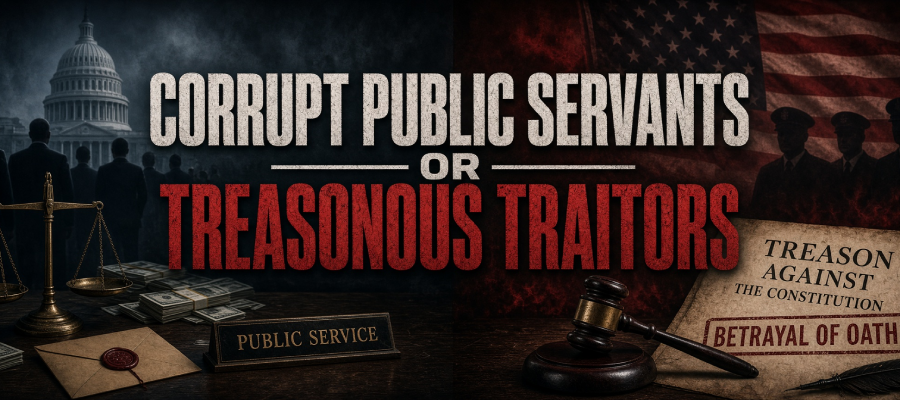
In my opinion, there is no higher calling than the security of our great nation. This is true whether we are talking about threats from afar or from within. Of course, it could also be argued that no greater threat to that security exists than corrupt public servants and traitors in our midst. A traitor is defined as one who betrays any confidence or trust, a betrayer, or someone who commits treason. Let’s explore the word “treason” for greater insight.
Treason: The betrayal of allegiance toward one’s own country, especially by committing hostile acts against it or aiding its enemies in committing such acts. The betrayal of someone’s trust or confidence. The offense of attempting to overthrow the government of the state to which the offender owes allegiance or of betraying the state into the hands of a foreign power; disloyalty; treachery.
Wow! That’s heavy! Of course, it could be argued that an uncomfortably high percentage of public servants are, in fact, nothing more than traitors, merely based on the definitions provided. Do you think I’m out of line or off-base? Before you pass judgment, let’s explore my reasoning.
Many of these corrupt public servants (politicians, law enforcement officials, bureaucrats, etc.) ignore their oath, disregard citizens’ rights, fail to uphold the vision of the Constitution, betray the trust of the people who put them into power, seek to seize more authority for personal gain, wield their power against the citizenry instead of for them, deliberately obstruct progress for the American people, prioritize their allegiance to their party, department, or foreign government over their own country or community, betray foundational principles for foreign ideologies, and display outright disloyalty to this nation, its people, or both. So, what do you call that? Well, by definition…
Am I Wrong?
Indeed, I could be wrong. The threat could be inflated in my head. So, let’s use Contrastive Inquiry to see if my argument holds any water. To argue that these individuals are not traitors, one must first establish that they DO remain loyal to their oath, their country, and their people. So the question becomes: how many politicians, bureaucrats, and public officials have demonstrated clear loyalty to the Constitution and Bill of Rights?
I’m going to need your help on this one, because I’m coming up short on names. In fact, I can think of only a few politicians that even get close. Moreover, I have found thousands of videos on YouTube demonstrating my point about law enforcement or state governments. In fact, guys like The Civil Rights Lawyer make a solid income exposing those examples.
Of course, if the primary measure of a public servant’s effectiveness is how closely they bring the nation toward the full realization or defense of these foundational documents, then failure to do so should be treated as failure in their position, right? Granted, failure doesn’t necessarily equate to treason; I’ll give you that. However, many in power are not simply negligent; they are actively working against the principles they swore to uphold.
Consider the repeated instances of politicians disregarding the rule of law, leveraging their positions for financial or political gain, the endless pandering to political parties, and enabling policies that erode individual freedoms. When public servants align themselves with global interests, corporate donors, or political factions over the welfare of the American people, they betray their true duty. It’s that simple. If a soldier were to defect to an enemy force, we would not hesitate to call that treason. So, then, why should it be any different when a politician or bureaucrat sells out their own country through policy, influence, or inaction? I don’t think that it’s any different at all.
What Can We Do?
The first and most critical step is to change how we select public officials. If we want a better situation, then we have to understand the game we are playing. With that, we must stop giving power to those who abuse that power. The answer is simple: reject the culture of party loyalty and measure politicians solely by their adherence to the Constitution and their ability to serve the American people rather than themselves. Of course, this means:
- Actually knowing what we are holding everyone accountable to.
- Holding politicians accountable for their actions rather than their rhetoric.
- Voting based on principles, not party lines.
- Rejecting any candidate who seeks power for personal enrichment rather than national service.
- Advocating for term limits to prevent career politicians from entrenching themselves in corruption.
- Demanding transparency and severe consequences for those who violate their oaths.
- Educating citizens on the importance of their role in governance—power is not simply given to politicians, it is transferred by the people.
YIKES! Principles, education, and accountability? These are likely to be tall orders to fill these days. However, that doesn’t make the advice any less accurate.
The Measure of Corrupt Public Servants
The measure of a public servant is simple: how closely do they bring us to the full realization or defense of the Constitution and Bill of Rights that they swore to uphold and defend? If they fail in this singular duty, they have failed as our servants. If they actively undermine these principles (whether through legislation, executive orders, or judicial activism), then they have not only failed but have betrayed the very nation they pretend to serve. If we refuse to see it any other way, I can promise you that it will continue.
There is no gray area here. A public servant who serves themselves, their party, a foreign entity, or corporate interests over their country is not merely corrupt; by definition, they are a traitor. Now, many are not going to like what I say here, but if the people continue to thrust these traitors into power, then that actually makes them complicit. The truth is that the responsibility falls upon the people to recognize this distinction, to hold these individuals accountable, and to ensure that power is only transferred to those who will wield it in defense of liberty rather than in pursuit of personal gain. However, this requires us to be principled enough to adhere to this philosophy regardless of what letter follows their name or what title they might hold.
Now, if you had any emotional tug while reading this, then I would highly encourage you to read it again. Emotion drives bias. Attempt to read this without a biased lens, and you’ll likely see the systemic nature of this problem. Nonetheless, the original question remains. Do we have corrupt public servants or treasonous traitors? Well, it’s sort of a trick question, because it’s bad news for the people either way.
If you enjoyed this article, you might also like Alexander Hamilton: The Man You Thought You Knew
Also, be sure to check out my article Temporary Safety, Permanent Record about Flock cameras on X.