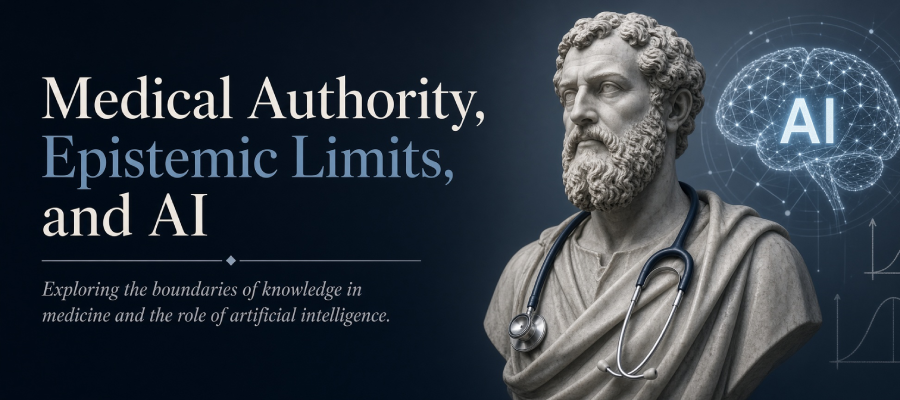
Modern medicine operates under a structural and pronounced contradiction that is rarely examined or acknowledged. Physicians are primarily trained as high-reliability operators. Rightfully so. However, they are also granted epistemic authority that extends far beyond this role. Indeed, this arrangement functions adequately in acute contexts, such as trauma care, surgical emergencies, and infectious disease management, where adherence to protocols and rapid execution are crucial for saving lives. However, when this same reliability-first model is extended into chronic, ambiguous, and multicausal disease states, memorization and algorithmic execution become highly insufficient substitutes for mechanistic reasoning and model defense.
This topic is critically important. Chronic disease in the United States represents the dominant pattern of morbidity and mortality, far exceeding niche concerns. Approximately 194 million American adults live with at least one chronic condition, with prevalence ranging from 6 in 10 young adults to 9 in 10 older adults (Watson et al., 2025). In 2021 estimates, diabetes affected 38.4 million Americans, while 97.6 million adults had prediabetes (Centers for Disease Control and Prevention, 2024). These conditions drive the majority of healthcare utilization and long-term disability. Approximately 90 percent of the nation’s $4.9 trillion in annual health expenditures is incurred by people with chronic and mental health conditions, rather than solely by spending confined to the treatment of those conditions themselves (Centers for Disease Control and Prevention, 2025). The burden has increased steadily over decades with no signs of abatement, highlighting the urgent need for mechanistic reasoning over exclusive reliance on protocols. This is to say that if the system and recommendations were right, things would not be so wrong.
That said, the persistence of public trust in medical authority is not irrational, but it is absolutely context-dependent. Protocol-driven medicine performs well when variables are constrained, and outcomes are immediate. In contrast, conditions such as neurodegenerative disease, fibrotic syndromes, post-infectious illness, and poorly characterized pain and fatigue syndromes unfold over long periods of time, involve interacting biological systems, and resist single-cause explanations (Clauw, 2014; Wolfe et al., 2016). Failures in these domains are diffuse rather than spectacular, manifesting as delayed diagnoses, fragmented care, and therapeutic stagnation. Because no single error is obvious, the system remains largely insulated from scrutiny, allowing authority to outpace adaptability.
Training for Reliability Versus Training for Explanation
Medical education typically emphasizes memorization and procedural competence because the healthcare system prioritizes reliability and error minimization. The preclinical years of medical school focus on absorbing large volumes of established knowledge, often privileging recall over integration (Irby et al., 2010). Clinical years then reinforce pattern recognition and guideline compliance, where success is measured by adherence to existing algorithms rather than by questioning their scope or limitations (Cooke et al., 2010). Residency and fellowship further reinforce this orientation by rewarding speed, consistency, and adherence to protocol under pressure. However, the often-missed divide is between new knowledge, existing knowledge, and applied knowledge.
This structure produces clinicians who are highly skilled at execution within known domains but comparatively underprepared for epistemic ambiguity. Pathophysiology is taught, and physician-scientist pathways exist. The issue is incentive and emphasis. Mechanistic reasoning, defined as the ability to trace causal pathways, challenge underlying assumptions, and defend explanatory models, is not the capacity the modal training system systematically selects or rewards (Howick, 2011). Howick’s account is qualified: mechanistic inference is more error-prone than is often assumed and is not required when high-quality controlled evidence already exists. In underdetermined domains, however, it remains a form of evidence rather than an optional flourish. As a result, when medicine encounters conditions without clean biomarkers or consensus pathways, it often defaults to symptom management rather than explanatory inquiry. Fibromyalgia, chronic fatigue syndromes, fibrotic disease, and other poorly characterized conditions demonstrate this limitation, where operational competence substitutes for understanding without resolving the underlying problem (Wolfe et al., 2016).
Doctoral Training and the Production of Epistemic Explorers
In contrast, doctoral training in research-oriented disciplines is explicitly designed to cultivate epistemic exploration. Doctor of Philosophy programs require candidates to generate original ideas, design studies, analyze data, and defend their conclusions against sustained critique (Council of Graduate Schools, 2008). This process prioritizes hypothesis generation, model construction, and iterative refinement, often across multiple years of independent investigation. In fields such as systems biology, epidemiology, and related biomedical sciences, the outcome is not merely subject matter expertise, but a durable capacity to operate at the boundary of the known and the unknown.
Doctor of Education programs, particularly those shaped by the Carnegie Project on the Education Doctorate, offer a complementary form of epistemic training oriented toward applied inquiry in real-world systems (Shulman et al., 2006; Perry, 2015). That training is not one thing. Some EdD programs emphasize organizational dynamics, policy, and the design of care and education systems. Others, including health education, health promotion, kinesiology, wellness, and nutrition tracks, require original research on health behavior, behavior-related disease, and, in some programs, nutrition science itself. In all of these tracks, candidates are required to generate original ideas, design studies, analyze data, and defend their conclusions against sustained critique. That work can produce defensible models of chronic, multicausal illness and of the conditions that sustain it. This is not to suggest a substitute for licensed diagnosis and treatment, and it is not identical to a systems-biology or pathophysiology PhD. However, it is still explanatory work the current clinical monopoly keeps out of the encounter.
Despite these strengths, both PhD and EdD holders are largely excluded from direct clinical practice. Licensure restricts diagnosis and treatment of individual patients to holders of medical credentials. It does not, by itself, bar research, guideline development, modeling, education, or advisory roles (Johnson & Chaudhry, 2012). The practical effect is still a narrowing. Expertise aligned with chronic, multicausal disease, whether mechanistic, behavioral, nutritional, or organizational, is kept at a distance from the point of care. If given any real thought, this asymmetry creates a structural paradox in which those most practiced at generating and defending models are institutionally limited in applying that practice where patients encounter it. Patients absorb the cost of that distance.
The Monopolization of Clinical Authority
Medical practice in the United States operates as a tightly regulated monopoly, where licensure and clinical authority are restricted to holders of medical degrees. This structure emerged historically to standardize care and “protect” patients from unqualified practitioners (Hamowy, 1979; Johnson & Chaudhry, 2012). Over time, however, it has evolved into a gatekeeping mechanism that excludes alternative forms of expertise from the clinical encounter, even when those forms are demonstrably relevant and valuable.
PhD and EdD holders with deep expertise in systems biology, epidemiology, cognitive science, or organizational dynamics face insurmountable barriers to clinical participation without retraining as physicians. This exclusion persists regardless of their capacity to contribute meaningfully to diagnosis, modeling, or treatment design in complex cases (Johnson & Chaudhry, 2012). The result is a narrowing of permissible perspectives in clinical decision-making, particularly in areas where existing protocols are inadequate.
The consequences of this monopoly extend beyond professional inequity. By privileging operational reliability over exploratory depth, the system reinforces a feedback loop in which acute successes validate authority while chronic failures remain unresolved (Hamowy, 1979). Patients who could benefit from an interdisciplinary examination are left without it. Innovation and exploration are constrained not by a lack of insight, but by a lack of permission at the point of care. Hence, conditions that require new explanatory frameworks are instead managed within outdated ones, perpetuating stagnation and prolonging suffering for those who need help the most.
Artificial Intelligence as an Epistemic Bridge
Artificial intelligence introduces a potential rupture in this structure by enabling mechanistic reasoning at scale, independent of credential dependence in generating candidate models. Unlike human clinicians, who are constrained by training pathways and liability concerns, AI systems can integrate heterogeneous data, test competing models, and revise hypotheses dynamically (Topol, 2019). In chronic and ambiguous disease states, this capacity aligns with the type of reasoning that is currently scarce in routine care (Rajkomar et al., 2019). The intent is not to displace clinicians, but to reintroduce systematic mechanistic reasoning into domains where protocol-driven care has reached its explanatory limits.
AI systems can synthesize genomic, environmental, behavioral, and clinical data to identify patterns that evade protocol-based approaches. They can simulate long-horizon disease trajectories, explore multicausal interactions, and surface plausible mechanisms rather than relying only on symptom categorization (Obermeyer et al., 2019). Current systems do not judge ideas on merit alone. They inherit the biases of their training literature, citation patterns, and institutional data. Their clinical use remains gated by regulation, liability, and physician authority. What they can do is host competing models at a scale no individual clinician can maintain, and they can index work that licensure would otherwise keep outside the exam room.
The broader implication is that AI may indirectly reintroduce PhD- and EdD-level reasoning into clinical contexts by embedding it within decision-support tools. In doing so, it can route around institutional monopolies without directly dismantling them (Topol, 2019). Physicians remain responsible for care delivery, but epistemic exploration need not be limited to what a single training pathway permits. This rebalancing has the potential to change how medicine approaches chronic and complex diseases. That change is necessary. Making research searchable and machine-accessible is a prerequisite for entering that conversation. It is not sufficient. Validation, uncertainty display, and accountability still sit with licensed actors.
Toward a Reconfiguration of Medical Authority
The central problem in modern medicine is not a lack of intelligence or goodwill, but a misalignment between authority and epistemic capacity. Reliability has been elevated beyond its appropriate domain, and execution has displaced explanation. PhD training pathways demonstrate that models of expertise exist for navigating mechanistic uncertainty. EdD training pathways demonstrate that models exist for designing systems that can absorb that uncertainty in practice (Shulman et al., 2006; Perry, 2015). Their exclusion from the clinical encounter reflects institutional inertia rather than a complete account of what the work requires.
Artificial intelligence represents the first scalable mechanism capable of correcting part of this imbalance. By employing contrastive inquiry and long-horizon reasoning, AI can challenge epistemic rigidity without necessitating an immediate structural overhaul of licensure. In doing so, it offers a path forward that neither replaces clinicians nor sanctifies existing hierarchies. Instead, it restores a missing dimension of medical practice, the disciplined exploration of what is not yet understood.
If outcomes matter, then medicine needs to evolve. If medicine is to evolve beyond its current limitations, authority must once again be tethered to explanatory power. AI may be the catalyst that makes that reattachment difficult to avoid. Millions of patients are already living inside the delay. For them, the evolution cannot come quickly enough. Thankfully, the foundation of that evolution may be right in front of us. Accordingly, PhD and EdD experts who want their models in that conversation must make the work searchable, inspectable, and capable of surviving critique inside clinical systems that will still require a licensed decision-maker to execute the information provided. This is interdisciplinary collaboration at its best, and that light is beginning to shine much brighter.
This article is published as a scholarly position paper that examines the structural and epistemic limitations in modern medical practice. It is not a clinical guideline, medical advice, or a substitute for professional care. Its purpose is analytical and exploratory, intended to advance discussion on authority, training models, and the role of artificial intelligence in complex disease reasoning. If you enjoyed this position paper, you might also enjoy The Persistence of Outdated Medical Knowledge
References
Centers for Disease Control and Prevention. (2024). National Diabetes Statistics Report. U.S. Department of Health and Human Services. https://www.cdc.gov/diabetes/php/data-research/index.html
Centers for Disease Control and Prevention. (2025). Fast facts: Health and economic costs of chronic conditions. U.S. Department of Health and Human Services. https://www.cdc.gov/chronic-disease/data-research/facts-stats/index.html
Clauw, D. J. (2014). Fibromyalgia: A clinical review. JAMA, 311(15), 1547–1555. https://doi.org/10.1001/jama.2014.3266
Cooke, M., Irby, D. M., & O’Brien, B. C. (2010). Educating physicians: A call for reform of medical school and residency. Jossey-Bass.
Council of Graduate Schools. (2008). Ph.D. completion and attrition: Analysis of baseline program data. Council of Graduate Schools.
Hamowy, R. (1979). The early development of medical licensing laws in the United States. Journal of Libertarian Studies, 3(1), 73–120.
Howick, J. (2011). Exposing the vanities—and a qualified defense—of mechanistic reasoning in health care decision making. Philosophy of Science, 78(5), 926–940. https://doi.org/10.1086/662561
Irby, D. M., Cooke, M., & O’Brien, B. C. (2010). Calls for reform of medical education by the Carnegie Foundation. Academic Medicine, 85(2), 220–227. https://doi.org/10.1097/ACM.0b013e3181c88449
Johnson, D. A., & Chaudhry, H. J. (2012). Medical licensing and discipline in America: A history of the Federation of State Medical Boards. Lexington Books.
Obermeyer, Z., Powers, B., Vogeli, C., & Mullainathan, S. (2019). Dissecting racial bias in an algorithm used to manage the health of populations. Science, 366(6464), 447–453. https://doi.org/10.1126/science.aax2342
Perry, J. A. (2015). The Carnegie Project on the Education Doctorate. Change: The Magazine of Higher Learning, 47(3), 56–61. https://doi.org/10.1080/00091383.2015.1040712
Rajkomar, A., Dean, J., & Kohane, I. (2019). Machine learning in medicine. New England Journal of Medicine, 380(14), 1347–1358. https://doi.org/10.1056/NEJMra1814259
Shulman, L. S., Golde, C. M., Bueschel, A. C., & Garabedian, K. J. (2006). Reclaiming education’s doctorates: A critique and a proposal. Educational Researcher, 35(3), 25–32. https://doi.org/10.3102/0013189X035003025
Topol, E. J. (2019). Deep medicine: How artificial intelligence can make healthcare human again. Basic Books.
Watson, K. B., Wiltz, J. L., Nhim, K., Kaufmann, R. B., Thomas, C. W., & Greenlund, K. J. (2025). Trends in multiple chronic conditions among US adults, by life stage, Behavioral Risk Factor Surveillance System, 2013–2023. Preventing Chronic Disease, 22, Article E15. https://doi.org/10.5888/pcd22.240539
Wolfe, F., Clauw, D. J., Fitzcharles, M. A., Goldenberg, D. L., Häuser, W., Katz, R. L., Mease, P., Russell, A. S., Russell, I. J., & Walitt, B. (2016). Revisions to the 2010/2011 fibromyalgia diagnostic criteria. Seminars in Arthritis and Rheumatism, 46(3), 319–329. https://doi.org/10.1016/j.semarthrit.2016.08.012