The Colorado River Shortage Is a Security Problem
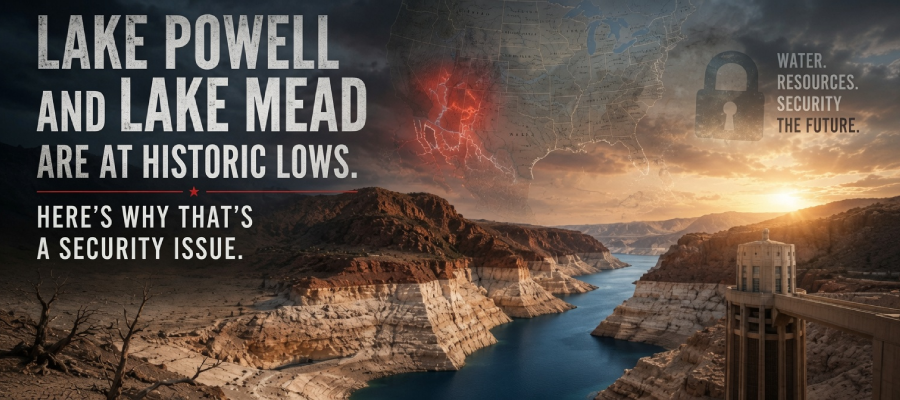
Lake Powell and Lake Mead have reached their lowest combined storage levels since 1957, before Powell was even filled. Powell sits at roughly 23 percent capacity. Mead sits at 27 percent. Together these two reservoirs supply water to approximately 40 million people, irrigate more than 5 million acres of farmland, and generate hydropower for around 700,000 homes across Arizona, California, Colorado, Nevada, New Mexico, Utah, and Wyoming.
Years of drought and rising demand have combined with a record-dry, record-warm winter to gut snowmelt inflows, the primary source that refills both reservoirs. Experts project continued daily record lows through next spring. If levels drop further, Glen Canyon Dam could lose its ability to even generate hydropower as early as March 2027, a threshold engineers call minimum power pool. Water deliveries to the lower basin states risk becoming unreliable well before that. The 2007 Interim Guidelines expire at the end of 2026, and negotiations among the seven basin states over reduced allocations remain unresolved. The problem is that even a strong El Niño winter wouldn’t restore safe buffer levels quickly enough to make any significant difference.
Most coverage of this story treats it as an environmental or agricultural crisis. That framing isn’t necessarily wrong, but it is definitely incomplete. What’s unfolding on the Colorado River is a slow-motion infrastructure-security event, and I believe it should be read through that lens if the response is going to be any good.
Why This Is a Security Problem, Not Just a Resource Problem
The Cybersecurity and Infrastructure Security Agency classifies the ability to supply water as a National Critical Function, a designation reserved for systems whose disruption would simultaneously have a debilitating effect on national security, economic stability, and public health. That designation exists because water infrastructure does not fail in isolation. It fails into other systems. This situation fits that bill to the letter.
The Department of Energy has documented the water-energy nexus in detail: water is required at every stage of electricity generation, and electricity is required at every stage of water delivery, from pumping stations to treatment plants. Glen Canyon Dam is the clearest example of a situation within the current crisis. It is simultaneously a water-delivery mechanism and a power-generation asset for the region, which means a single point of physical stress threatens two critical functions at once, not just one. When a system is built this tightly coupled, a failure in one node rarely stays contained. Instead, it usually cascades into the sectors that depend on it, and those cascading effects are precisely what security planning exists to anticipate.
In many ways, the interstate governance layer compounds the physical risk. Seven states currently operate under a legal allocation framework built in an era of far higher river flows, and that framework has not been renegotiated fast enough to match current hydrology. This is an institutional failure, and it’s an institutional failure under physical stress, which is a textbook security scenario. Think about it. The infrastructure degrades gradually, while the decision-making apparatus meant to respond to it moves more slowly than the problem does.
Granted, none of this means a collapse is imminent. Immediate widespread cuts are not currently occurring, at least so far. However, the system is now operating close enough to its structural threshold that the probability of staged reductions, in both water deliveries and power generation, is rising, and rising probabilities are exactly the kind of signal that should move a household or a business from monitoring to preparation. In fact, I would argue that any responsible person should already be taking steps.
What to Do Now
Security planning is a bit of an art form. The goal here is continuity, not crisis response. The thing to keep in mind is that continuity planning starts before the crisis, not during it. Of course, this means that you have a lot of input on what your situation will look like if (or when) that crisis occurs. Here are some things to think about.
Water: Store one to two weeks of potable water, calculated at one gallon per person per day as a minimum, in food-grade containers rotated approximately every six months. A gravity filter or a chemical treatment method extends that reserve if the disruption runs longer than expected. On the demand side, install low-flow fixtures, repair leaks immediately, and, where local code allows (which is insane, btw), capture graywater for non-potable outdoor use. None of this requires assuming the worst. It only requires assuming the reserve buffer that has protected the system for decades is thinner than it used to be, because it is. For clarity on that, understand that the Colorado River system storage is now around 33 percent of capacity.
Power: Given the direct link between this specific reservoir system and regional hydropower, a modest battery backup or generator sized to essential loads, refrigeration, medical devices, lighting, and communications is a reasonable contingency. Rotate fuel and test the system monthly. If you want to kick it up a notch, solar paired with battery storage further extends independence for those with the budget. Identify your utility’s contingency plans directly and sign up for outage alerts now, before an event makes that channel harder to reach.
Information discipline: Yes, you could rely on social media, but you shouldn’t. You could rely solely on local news reports, but again, you shouldn’t. Keep these in the mix, but include other primary sources as well. For example, you could monitor the Bureau of Reclamation’s reservoir reports and your state water authority’s notices directly. The reason is that secondhand media summaries tend to compress technical detail in ways that either understate or sensationalize the actual risk. Also, if you live in or own property within the basin states, review your water rights and any relevant HOA restrictions now, while there is still time to act on what you find rather than react to it.
The Ripple Effect
Now, you might think that if you don’t live within those seven states, you’re in the clear. That’s a mistake. While it’s true that most households outside the immediate delivery footprint face low direct risk from the reservoirs themselves, the reality is that the exposure reaching everyone else runs through second-order effects. A few examples make the point better than any general statement could.
The Yuma, Arizona region alone, irrigated entirely by Colorado River water, grows over 90 percent of the leafy greens Americans and Canadians eat between November and March, meaning a shopper in Ohio buying winter lettuce is already dependent on this river without knowing it. If the system fails here, prices might go up, availability might dwindle, or that produce might get sourced from other nations to meet demand. Either way, American workers and families feel it.
Before that lettuce ever reaches a plate, though, the river is already doing something most people never think to ask about. Nearly half of all water diverted directly from the Colorado River, roughly 46 percent, goes toward alfalfa and other cattle-feed crops, more than every city and industry in the basin combined. That feed doesn’t stay local. It moves by rail and truck into feedlots and dairy operations across the country, so a tightening water supply doesn’t just threaten Arizona lettuce fields. It threatens the input side of the entire national beef and dairy supply chain. On a very basic level, a shortage upriver shows up months later as a higher grocery bill in a state that has never given the Colorado River a second thought.
On the power side, the Western Interconnection ties Glen Canyon Dam’s output into a regional grid that spans well beyond the basin states. If there’s a hydropower shortfall, it doesn’t stay local. Wholesale electricity costs rise across a grid other states also draw from, which means prices go up for everyone tied to that alternate system. On that note, I feel compelled to share that the system was built with the assumption that the lakes would be full. However, generation efficiency declines well before minimum power pool because of reduced hydraulic head. At current elevations, the water volume required per megawatt-hour is already materially higher than at full pool. This tells us that the potential threat has actually already begun, even if it hasn’t fully registered yet.
The examples go on, but hopefully you get the point. Either way, basic preparedness reduces that exposure regardless of geography, which is the entire point of thinking about infrastructure through a security frame instead of a weather frame. Weather comes and passes. Structural shortages don’t resolve themselves on a seasonal clock, and treating this one as though it will is the single biggest planning error available right now. We can hope for a heavy winter in the Rockies, but for now, proper planning is far more actionable than hope.
Did you get something out of this article? You might also like Procure and Store Water During a Crisis