Recipe: The Omnivore Korean Beef Bowl
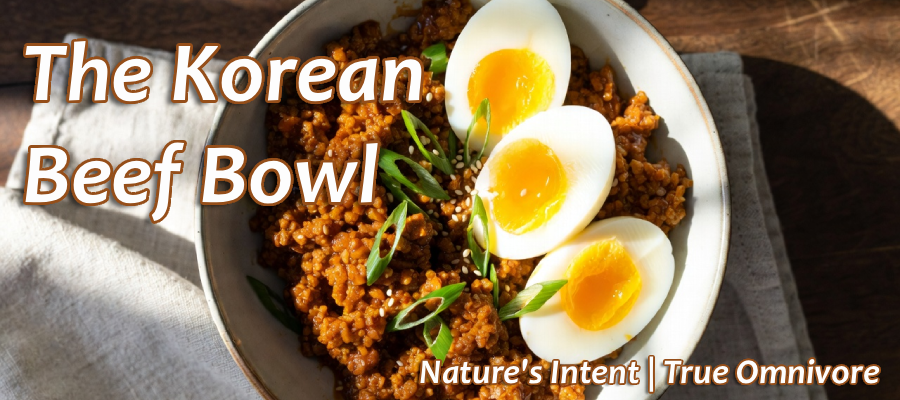
Sticking to the “True Omnivore” diet doesn’t have to be a chore, and not every meal needs to be built from scratch to align with the principles of Nature’s Intent. The Korean Beef Bowl is no exception. In fact, sometimes the better approach is to recognize a dish with strong bones and remove what doesn’t belong.
In its original form, this dish carries an unnecessary carbohydrate load from rice and brown sugar. Strip those out, make one clean substitution in the sauce, and what remains is a nutrient-dense, animal-protein-centered meal that fits the True Omnivore framework without sacrificing any of the flavor that makes it worth cooking in the first place. Let’s dig in!
Korean Ground Beef Bowl
A True Omnivore adaptation. All the flavor. None of the compromise.
Ingredients
Sauce
¼ cup coconut aminos
4 cloves garlic, finely minced or grated
1 Tbsp roasted sesame oil
1 Tbsp rice vinegar
1 Tbsp fresh ginger root, grated
1 tsp chili garlic sauce
Bowl
1½ lbs ground beef
3 green onions, sliced — green and white parts separated
4 eggs
4 tsp butter
Sesame seeds, optional garnish
Directions
Whisk together all sauce ingredients and set aside.
Place a large pan over medium-high heat. Add ground beef and brown, breaking the meat up as it cooks until done, approximately 4 to 6 minutes.
Pour the sauce over the meat and bring to a simmer. Stir in the white parts of the green onions and cook for 3 to 4 minutes.
Prepare eggs using one of the following methods:
Over-Easy (Fried)
Heat a frying pan over medium heat and melt 1 tsp butter per egg. Crack eggs into the pan carefully, keeping yolks intact. Reduce heat to low. Fry until whites are fully set, then flip briefly, no more than 30 seconds. Yolks should remain soft and runny.
Soft-Boiled
Bring a pot of water to a boil. While water heats, submerge eggs in hot tap water for 5 to 10 minutes to bring them to room temperature. Once water is boiling, transfer eggs and cook for 6 to 7 minutes. Move immediately to an ice bath for 2 to 10 minutes depending on desired firmness. Peel and halve before serving.
Serve the beef topped with an egg. Garnish with green onion tops and sesame seeds if desired.
Notes
Coconut aminos replaces soy sauce in alignment with the Nature’s Intent framework. Rice and brown sugar are omitted. Roasted sesame oil is used as a flavor-based exception in minimal quantity. A soft or runny yolk is the nutritionally preferred preparation for eggs, preserving choline and heat-sensitive nutrients.
Ground Beef: The Underappreciated Foundation
In my opinion, ground beef doesn’t get the nutritional respect it deserves, largely because decades of flawed dietary guidance positioned saturated fat as a public health villain. Of course, that narrative hasn’t held up well under scrutiny, and the True Omnivore framework never accepted it to begin with. Ground beef is one of the most complete nutrient packages available. It delivers heme iron, the form most bioavailable to the human body, alongside zinc, selenium, B12, creatine, carnosine, and CoQ10.
These are not incidental nutrients. Creatine supports neurological function and muscular energy metabolism. Carnosine is a dipeptide with significant antioxidant and anti-glycation properties. CoQ10 is a mitochondrial cofactor that the body produces less of with age and that no plant food delivers in meaningful quantity. These are all big wins!
And let’s talk about the saturated fat for a moment. The saturated fat in ground beef is a substrate. Saturated fat supports hormone synthesis, maintains cellular membrane integrity, and facilitates the absorption of the fat-soluble vitamins that arrive alongside it. Hence, choosing a fattier grind (to your liking) is not a compromise. It is the nutritionally coherent choice.
The Egg: Whole, Intact, and Non-Negotiable
The eggs in this dish are a second complete protein source layered on top of the beef, and together the two deliver a nutrient density that is difficult to replicate with any other combination of foods. Eggs provide choline, a nutrient chronically underconsumed in modern diets and essential to liver function, neurotransmitter synthesis, and the structural integrity of every cell membrane in the body. They also deliver fat-soluble vitamins A, D, E, and K2, along with lutein and zeaxanthin for ocular health, and selenium in a highly bioavailable form. And best of all, it’s a great source of sulfur, which is slowly being recognized as a nutrient that is grossly overlooked in many instances.
Now, the preparation method matters here. This dish works with two egg approaches, and both are worth knowing. The first is a fried egg cooked over-easy in butter, yolk intact and soft. The second is a soft-boiled egg: bring water to a boil, then place eggs in hot tap water for five to ten minutes to bring them to room temperature, cook for six to seven minutes, then place in an ice bath for two to ten minutes. Both methods preserve the yolk in a soft or runny state, which is nutritionally significant. Overcooking the yolk oxidizes the cholesterol it contains and degrades heat-sensitive nutrients, including choline. A soft or runny yolk is the more nutritionally sound preparation.
Butter is the correct fat for frying. It contributes additional fat-soluble vitamins, conjugated linoleic acid, and butyrate, a short-chain fatty acid with documented roles in gut lining integrity and inflammatory regulation. There is no nutritional argument for substituting a seed oil here.
The Substitutions and Why They Matter
Two changes from the original recipe define the True Omnivore version of this dish. The first is the removal of rice. Rice is a grain, and the Nature’s Intent framework identifies grains as foods that introduce anti-nutrient burden, displace more nutrient-dense options, and contribute carbohydrate load without meaningful micronutrient return. And now, removing the rice doesn’t diminish the dish. If anything, it improves it! The beef and egg provide the satiety and substance that rice was never genuinely necessary for.
The second change is replacing soy sauce with coconut aminos. Soy is a legume that contains phytoestrogens and compounds that interfere with zinc and thyroid function. Coconut aminos deliver a comparable depth and umami character with a fraction of the sodium and none of the hormonal burden. It is the cleaner choice by every relevant measure.
The brown sugar is removed without replacement. The sauce simply doesn’t need it. The coconut aminos carry a mild natural sweetness, and the garlic, ginger, rice vinegar, and chili garlic sauce provide more than enough complexity. Removing refined sugar from a savory protein dish sharpens the flavor profile while eliminating the one ingredient with no nutritional justification.
Normally, I would guide people away from it, but the roasted sesame oil is used in such a small amount in the sauce and is included here as a flavor-based exception. It adds an aromatic depth that is difficult to replicate, and the amount used does not meaningfully alter the meal’s nutritional character or cause harm.
Now, you might be wondering about the inclusion of antinutrients at all. Sure, if you want to be super-strict, removing the antinutrient compounds entirely is an option. However, it’s not really required here because the amount is so low. Remember that dose determines effect, and the quantity used here (in comparison to the rest of the dish) sits well below the threshold at which they meaningfully impair mineral absorption. Moreover, at trace levels, they function as mild stressors, and the body answers by upregulating its own defensive machinery, which includes glutathione synthesis. Hence, at least in this specific recipe, the adaptive response delivers the net benefit. Quantity is the operative variable, and we need to know the difference. A trace amount provokes adaptation. A diet built on them produces chronic interference.
Korean Beef Bowl: The Bigger Picture
The Korean Ground Beef Bowl, adapted for the True Omnivore framework, is a practical demonstration of how this approach to nutrition works in a real kitchen. It is about precision. Remove what does not serve the body. Keep what does. The result, in this case, is a fast, satisfying, deeply flavorful meal built almost entirely on animal protein, animal fat, and a sauce that earns every ingredient in it. That is the point.
If you’re looking for more True Omnivore Recipes, you might like: