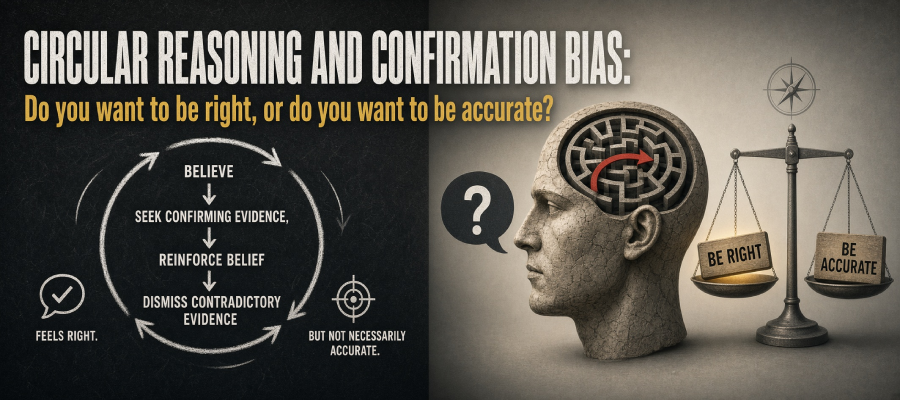
Most people will tell you they want the truth. I hear it constantly, and I believe they mean it. However, most of us protect, more often than we’d like to admit, the feeling that we already have the truth. Two habits do most of the work of keeping that feeling intact: circular reasoning and confirmation bias. Each one produces mistakes on its own. Together, they feed Epistemic Rigidity.
Two Habits That Protect Each Other
Circular reasoning is a logical fallacy in which you begin with the conclusion you’re trying to reach. The conclusion is written into the premises, so the argument never actually tests anything. You’ve probably heard a version of this: “This policy is correct because the experts who support it are reliable, and we know they are reliable because they support the correct policy.” The claim proves itself.
The everyday version shows up in personal arguments:
- “I know I’m right about this relationship because my friends who agree with me are the ones who really understand people.”
- “You must obey the law because it’s illegal to break the law.“
- “I know God exists because the bible says so, and the bible is always right because it’s the word of God.”
People assume the desired outcome first, then pick or shape the evidence to match it. They exclude anything that could challenge the claim before it has a chance to count. And that’s the problem, because it also blinds them to the loop they’re stuck in. Socialist and Marxist supporters are good examples. They like the idea of living off the government. However, the government has nothing to give that it didn’t first take from the people, but their reasoning never lets that important point in.
Confirmation bias is the tendency to seek out, interpret, and remember information that confirms what you already believe or expect. It shows up in which sources get your attention and which details you still remember after the conversation ends. In the examples provided, the relationship source remains the trusted friend, the law source is a cop or government official, and the God source is a preacher or the Bible itself. There is no contrast. No contrast means no perspective.
But it goes deeper than that. Say you already believe a particular diet is optimal. You’ll notice the success stories and the mechanisms that fit, while contradictory studies, physiology, and failed personal experiments go unexamined. Those ideas are now outliers, even if they’re valid. Political and professional settings work the same way. Once a preferred explanation is in place, new data gets sorted into two bins: “supports what I already think” and “probably flawed.”
The problem is that such sorting feels like careful evaluation. But that’s not what’s happening. In plain English, the sorting decides the outcome before any evaluation actually happens. So no learning or progress actually happens.
These two habits are tied at the hip because both decide what counts as evidence before anyone can actually examine it. Circular reasoning supplies the protected conclusion. Confirmation bias supplies the selective intake that keeps contradictory material from forcing a revision. So you keep going, being “right” even though you’re absolutely wrong.
I’ll just say that if you open every inquiry with an emphatic defense of the outcome you want, the questions you ask will already point toward that outcome, and any evidence or question that opposes your position will be a threat. Sources that challenge it get marked as less credible or less relevant before anyone reads what they actually say. Over time, the belief feels more certain, precisely because the process never allowed a real test.
Epistemic Rigidity describes the larger structure that results. It’s the condition in which cognitive biases, motivated reasoning, and selective attention reinforce one another, making inaccurate information harder to discard. Confirmation bias is one mechanism within that structure. Circular reasoning is one way the structure protects itself from challenge. When the two run together, the system favors familiar ideas (and agreeable people) and actively lowers the chance it will recognize better information. From the inside, the process feels thorough. From the outside, you can watch the same conclusion go in at the start and come out at the end.
The Places You’ll See It
Short answer: EVERYWHERE! Seriously!
Imagine someone tells a trusted friend about a new supplement. They heard it was great for immunity, and sure enough, they too see the ads saying the supplement “supports immunity.” In their head, they decide they could benefit from it as well. But they know they need to do their research first.
Their next searches focus on “benefits of supplement X,” mechanisms that sound supportive, and testimonials from people who felt better taking it. They’ve really done their homework!
However, more often than not, they ignored studies showing no effect and poor reviews, dismissing them as “industry-funded” or “not looking at the right population.” The reasoning started with the conclusion that the supplement is the answer, and everything after that was asked to confirm it, not prove it. Months later, the person still feels the decision was evidence-based (despite not feeling better). In reality, the evidence that could have changed those outcomes never entered the evaluation on equal terms.
The same thing happens in organizational and political judgment. A leader or commentator starts with the view that a certain policy or leadership style is responsible for current problems. The reading, conversations, and data reviews that follow focus on finding the supporting pattern. When outcomes contradict the view, people explain them as temporary, as interference, or as proof the policy wasn’t applied strongly enough. That last explanation is circular. People assume their preferred explanation is correct, so any failure becomes evidence that they need more of the same. Confirmation bias then makes sure the failures of the alternative approaches get more attention than the failures of the preferred one. You end up with a stable, inaccurate model that resists correction even as results drift further from the prediction.
We see it in evaluations of history all of the time. The New Deal is a great example. A progressive today usually reads it as proof that government action pulled the country out of the Great Depression. Social Security, job programs, and banking regulation protected ordinary people, and they draw the lesson that big federal programs work in a crisis. A conservative today often reads the same history as government overreach that dragged the recovery out. They point to unemployment staying high through the late 1930s, the 1937 to 1938 relapse, and programs that never went away once the emergency ended. The lesson they draw is that federal expansion slows recovery and builds permanent dependence.
It’s the same decade, and both sides look at the same unemployment figures and the same programs. So, who’s right? Each starts from a conclusion about what government should do, then picks the parts of the record that support it. That’s why the New Deal argument still hasn’t been settled almost a century later, and why both sides can’t see the validity of the other side’s arguments.
Of course, the smallest version shows up in ordinary disagreement, and I’d bet you’ve been in one recently. Two people argue about something that happened. Each starts with a firm sense of who was at fault, and each asks questions designed to get the other person to confirm the preferred sequence of events. Details that don’t fit get minimized or forgotten. Later, both can retell the conversation as clear proof that the other side refused to face facts. The circular element was the starting assumption. The confirmation bias element was the selective questioning and selective memory that followed. So ask yourself what the operating goal was in that conversation. More than likely, for both people, the goal was to leave the room still feeling right.
What It Costs You
I want you to understand that decisions made inside the loop tend to compound errors. In health, you may stick with an ineffective or costly approach while better options go unexamined. In leadership or policy, resources keep going to strategies whose results have already been explained away. In personal relationships and professional judgment, the same misreading of motives or outcomes repeats because the process never forced a genuine comparison. And the longer the loop runs, the more any challenge feels like an attack on your competence or integrity. At that point, information that could improve the model registers as a threat. Dysfunction continues until collapse, as the Adversity Nexus shows.
So what do you do about it? Start with a different first question. I think the Contrastive Inquiry Method saves the day more often than not. Before you defend a conclusion, appreciate nuance, and ask what contrastive evidence you would actually consider. Second, try to tear apart your own conclusion. If you can’t tear it apart, then it’s probably pretty solid. If you can tear it apart, it’s probably not worth investing in. Either way, we need to understand that circular reasoning gets harder to sustain once you can’t let the conclusion serve as its own premise. Moreover, confirmation bias becomes easier to see once you notice what kinds of information you set aside before you’ve evaluated them.
This advice works great for imperfect, biased people, which is all of us. It asks for one thing: a willingness to rank accuracy above the temporary comfort of being right. On that note, I should also warn you that you can be consistently right about a narrow set of claims and still be inaccurate about the larger system those claims sit inside. Circular reasoning and confirmation bias protect that narrow certainty, and they pay for it with the broader accuracy that would make your future decisions more reliable. Epistemic Rigidity is what that trade-off looks like once it has become a habit.
The good news is that you can make this choice at the start of any line of questioning. Just know that if your first move is an emphatic defense of the conclusion you want, and you let only information that supports it count, you’ve already chosen being right over being accurate. The rest of the inquiry will largely confirm the choice.
Just something to think about.