The Historical Pattern We’re Not Talking About
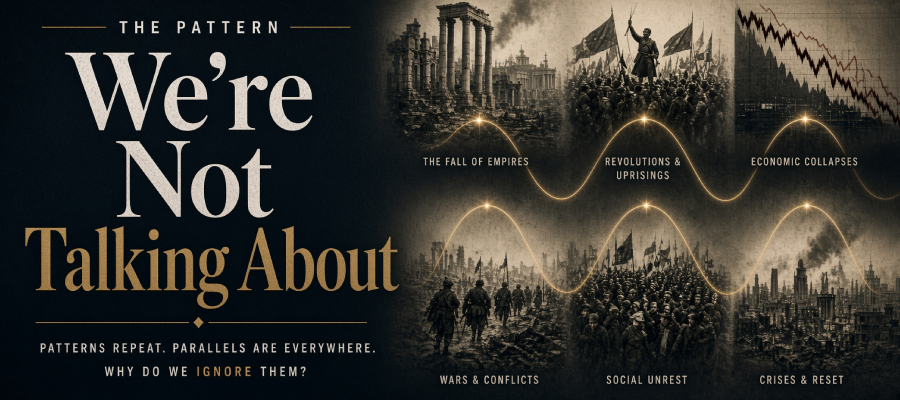
A lot of people are noticing something is off. I know because I receive several comments about it every week. Not just disappointed or frustrated with politics. But genuinely unmoored. The extremes are louder. The center is weaker. The people in charge seem to have lost the plot entirely. And nobody’s actually listening to anyone anymore.
If you’re feeling that, you’re not alone. And you’re not crazy. I have touched on this before, but what I find interesting is that when you start mapping what’s happening now against what happened in the 1930s, the parallels are real. Granted, they’re not identical. We’re not marching toward the exact same outcomes. But the structural pattern is definitely the same. And that pattern is worth understanding, because it tells us something about where this can go if things continue the way they’re going.
What Broke Then, What’s Breaking Now
The Great Depression didn’t just break the economy. It broke trust in the people who were supposed to manage the economy. Unemployment hit 25 percent. Savings evaporated. Entire classes of people went from middle-class stability to watching their security disappear in months. And the ruling class had no answers. Or, if they did, they had answers that didn’t work. At the very least, they seemed not to care.
We need to understand human behavior, because when people lose faith in existing institutions, they start looking for alternatives. Any alternatives. That’s when the extremes show up.
Some experts might argue that today’s version is softer in absolute terms. However, I would argue that today’s version is directionally identical. The official unemployment rate sits around 4 percent, which sounds fine until you dig deeper. LISEP’s True Rate of Unemployment (the metric that counts the jobless, people working part-time involuntarily, and those earning below a living wage) sits at 24.7 percent. That’s roughly one in four working-age Americans in functional economic distress. Add in participation rates at historic lows (61.4 percent), housing that’s unaffordable for most people, inflation that’s eaten into purchasing power, and you’ve got a population experiencing real hardship even if GDP numbers look okay.
Of course, the political consequence is predictable. When governing parties of both sides seem unable or unwilling to deliver basic competence, or worse, seem indifferent to whether they do, people stop defending the system. In fact, they start looking for someone who promises to blow it up.
The Middle Gets Squeezed
In the 1930s, European politics polarized into communist and fascist camps. Each treated the other as an existential threat rather than a political opponent. Parliamentary centrists got squeezed out. People stopped voting for “moderate” candidates because moderate seemed like surrender in either direction.
The United States is following a similar arc, just with different labels. You’ve got expanding socialist/communist currents within the Democratic coalition openly debating wealth redistribution and institutional redesign. You’ve got nationalist and populist movements on the right treating the administrative state, universities, and legacy institutions as captured enemies. Both sides increasingly frame political disagreement not as policy dispute but as moral emergency. The other side doesn’t just have wrong ideas; they’re corrupting civilization itself.
Meanwhile, the center is noisy but largely powerless. It lacks the institutional authority to enforce norms of restraint. Nobody’s listening to the moderate take anymore. Even well-known moderate voices are fading. Moderates don’t win movements. Moderates don’t inspire. Moderates seem weak, especially when things are breaking.
And make no mistake, things are breaking. So the extremes grow. That’s precisely what we’re seeing, isn’t it? Well, the hole gets deeper.
The Information Problem Got Worse
In the 1930s, radio and mass-circulation newspapers were new technologies. They let governments and political movements reach mass audiences quickly and shape emotional responses at scale. Radio made propaganda powerful. It made demonization of the enemy easier. It made conspiracy theories spreadable in ways older media simply couldn’t match.
Now imagine that system 100 times faster and fragmented into a thousand separate channels. Social media and algorithmic amplification do the same work radio did, except the system optimizes for engagement rather than truth. Engagement means emotional intensity. Emotional intensity means you and your opponent aren’t living in the same factual universe anymore. You’re consuming separate news feeds, separate explanations for what’s happening, separate villains, separate heroes. The algorithm isn’t trying to radicalize you; it’s trying to keep you on the platform. But keeping you on the platform means serving you content that makes you angry, afraid, or convinced the other side is illegitimate.
What you end up with is two large populations that don’t share basic facts and see the other side as a threat to their survival. I need you to understand that we’ve long passed simple disagreement. Historically speaking, that’s a collision course. Moreover, it seems few are interested in diverting.
Technology Is Rewriting the Game Faster Than Institutions Can Adapt
In the 1930s, military technology changed faster than military doctrine. Mechanized armor, radio communications, aircraft, and improved logistics made trench warfare obsolete. States that adapted fast (Germany, the Soviet Union) gained decisive advantages. States that clung to old models suffered catastrophic failure. But at the same time, that period saw the weaponization of radio and film for mass psychological manipulation. Information became a theater of conflict.
Current conditions repeat the pattern at both military and economic scales. On the military side, persistent surveillance and strike drones, AI-assisted targeting, loitering munitions, and electronic warfare are compressing decision cycles and reducing the value of traditional military platforms. The information domain has expanded. Algorithms can conduct influence operations at minimal cost. Cyber warfare, fake news, disinformation, astrofurfing, and psychological operations are continuous and global. In fact, you might want to do some research on the concept of Fifth-Generation Warfare, if you haven’t already. The point is that the means of conflict are shifting faster than institutional responses can keep up.
On the economic side, AI and robotics represent a general-purpose technology wave that’s disrupting labor markets faster than institutions can manage the redistribution of gains and losses. Early adopters capture surplus. Workers in exposed occupations face wage pressure or displacement. The feeling that the economic game is being rewritten under your feet while you have no say in the outcome is real.
And here’s the critical part: these problems reinforce each other. In many ways, they are predictive and diagnostic. A fundamental shift in the way the world does business and a new way of conducting warfare are signs, and that’s what we are watching.
You’ve got technological disruption creating economic pressure. Economic pressure creates political volatility and demand for radical solutions. Algorithmic amplification of grievance intensifies polarization. Polarization makes coherent institutional response harder. Institutions that can’t respond lose legitimacy. Loss of legitimacy creates space for more radical movements.
Interestingly, in the 1930s, this combination happened more slowly and with fewer information vectors. It still produced the political outcomes that engulfed the world. Well, today, it’s happening faster and with algorithmic acceleration.
The Structural Risk
The 1930s teach us what happens when multiple pressures align: economic dislocation, institutional failure, technology disrupting established power structures, and populations losing faith in the center. This typically leads to one thing. Granted, some might argue that the result isn’t predetermined. I agree, but I would argue that the options are narrowly constrained. The options historically have been: authoritarian consolidation on the left or right, sustained collapse and instability, or fundamental institutional reform that restores coherence and legitimacy. The question then becomes, which options are acceptable, and which ones will the people adopt?
That said, the United States does have some structural advantages the interwar democracies lacked, such as constitutional guardrails, federalism that disperses power, and electoral systems that still function (barely). Those matter. They’re real brakes on where this can go.
But brakes only work if the pads are healthy. Brakes only work if you use them before you go off the cliff. If constitutional guardrails are the brakes, we have to ask ourselves, when was the last time anyone checked the brakes? Do you think your politician, police officer, or military commander can tell you what Article 4, Section 4 of the Constitution is without looking it up? What’s the 9th Amendment? The point is that you cannot exercise, support, love, or defend something you do not know. How can you support or chase a vision that you refuse to examine or understand?
Pull back for a moment and consider the core pattern. Think about mutually exclusive political theologies, ignorance and easily-led followers, eroded shared factual ground, declining capacity of centrist institutions to command loyalty or enforce restraint. The point is that when large numbers of citizens conclude the other side is not merely wrong but illegitimate, and that existing rules no longer protect them, and they have zero interest in expanding their knowledge to understand the scope of what is happening, politics becomes zero-sum and increasingly coercive. Isn’t that pattern visible today?
The question isn’t whether the 1930s are coming. I think that boat has sailed. Instead, the question is whether the institutions and individuals with decision-making power can recognize this pattern early enough to do something about it. Or perhaps, does anyone care enough to do anything about it? Will anyone work to restore enough competence, coherence, and shared reality to rebuild trust before the system fragments further?
Looking back, it’s easy to see that the 1930s didn’t have to happen the way it happened. A few seemingly small decisions could have changed everything. But emotion drove, and once the underlying conditions were in place, the margin for institutional error narrowed dramatically. By the time people recognized the danger, the extremes had already grown too strong for the center to contain.
How far we proceed from here largely depends on whether governing elites recover competence and whether enough citizens still prefer ordered liberty to the satisfactions of tribal victory. But judging by the last several rounds of elections, and the projection of the coming ones, it doesn’t look like too many are interested in taking a different route.
Thankfully, wars and cultural shifts are typically won by the few who have a strong understanding of the vision and the intestinal fortitude to see it through. There is hope, but it’s going to require some guts to step in front of it, and teamwork and endurance to see it through. I just fear that, like previous cycles, too many are going to make their decisions too late.
If you got something from this article, you might also like: