I have been working through a theoretical model of how productive work could change as AI and robotics mature. I thought I would share it because it aligns well with the other cycles that I have shared in the past. The graph below is a high-level sketch of that model, illustrating relative shares over time (without assigning precise dates). One curve tracks work that still requires human labor, and the other tracks work that machines can perform autonomously. You can note how they move in opposite directions because they divide the same total. The point where they cross marks the moment when half of productive work no longer needs a person in the loop, and a shaded band marks the interval where that technical shift can collide with existing ways of distributing income and access.

The early part of the picture is already visible. Industrial robots have reduced employment and wages in the U.S. labor markets most exposed to them (Acemoglu & Restrepo, 2020). Generative systems have so far acted mostly as assistants. However, that is likely to change rapidly.
In a study of more than five thousand customer-support agents, an AI tool raised productivity by roughly fifteen percent while people still handled the interactions (Brynjolfsson, Li, & Raymond, 2025). Those gains are real, yet they leave humans in the supervisory role. However, this too is rapidly changing, as many have begun opening up completely autonomous small businesses online.
The steeper rise in the autonomous share depends on a further step: systems that can detect novel failures, recover, and keep operating without continuous oversight, at a cost that undercuts continued human labor. That threshold has not been crossed at scale in most domains, but it is likely on the way. Once it is, the share of work that still requires people begins to fall more sharply.
I think that the interval that matters most is the one the graph shades as a potential clash. I have written about this before, but history shows that with just about every major economic upheaval comes a clash of epic proportions. This clash is often both economic and geopolitically kinetic. We would be wise to recognize this truth and heed the warning. The signs are already visible. Of course, this can present itself in a variety of ways, but the shift is likely to be total.
That said, it will likely start small. Production capacity in automated segments can expand while most households still earn the bulk of their income through wages. The key point is that the mismatch typically does not wait for the economy-wide fifty-percent mark. It can appear as soon as displacement in high-volume sectors outruns the creation or re-pricing of new paid human tasks.
However, sectors will cross the autonomy threshold at different times, with manufacturing, logistics, and routine information processing likely moving earlier than care work, complex construction, or high-stakes professional judgment. The aggregate curve therefore lags the earliest local disruptions, and wage or demand pressure can register in specific markets well before the overall parity point. On that note, absolute hours of human work may hold steady or even rise if total output grows fast enough and complementary tasks appear, while the share that still requires human labor continues to decline.
In the later phase, the model contemplates lights-out production and capable autonomous AI systems becoming the normal mode for a large fraction of goods, logistics, and information services. Surplus in those domains is no longer tightly coupled to human labor hours. The relative price of machine-produced output falls, and the marginal value of additional human labor inside those domains collapses. This is a problem only if solutions for this shift have not already been deployed.
I can only imagine that institutions organized around wage mediation would continue to function as administrative or claims layers, but they would likely lose their former role as the primary channel between production and household purchasing power. Monetary and fiscal tools built for demand-management economies can still move nominal balances, but they would no longer allocate real resources in the same proportion once labor income accounts for a shrinking share of total output. At that point, the binding questions shift toward ownership of and residual claims on the automated systems, and toward whatever physical constraints remain, such as energy and materials. However, those questions are already being worked on by guys like Elon Musk.
Granted, in this new economy, human work does not necessarily vanish. It would likely persist by necessity in lagging sectors and by preference wherever craft, meaning, or direct social value remains. However, once ordinary access to machine-produced basics is secured through whatever claims structure emerges, that residual work really would become optional for most people, much as building furniture by hand became a craft once factory production made furniture abundant.
In this scenario, the old arrangements linger the way pre-digital household routines lingered: still preferred by some, still usable for limited purposes, but no longer sufficient for ordinary participation in the dominant technical regime. The final segment of the graph records that dominance. But it should be reiterated that dominance does not mean total removal. After all, there are (shockingly) still people alive today who get by just fine without computers or smartphones, while most would consider that to be “abnormal.”
Indeed, the institutional forms that will convert machine surplus into broad access remain open. However, history suggests the technical regime will force adaptations, both constructive and disruptive, without waiting for prior consensus. Your ability to adapt and leverage this shift remains in your hands. The graph offers only a generalized view of relative shares, but it does not map every sector or every possible distribution mechanism. What it does mark is the interval in which the technical clock and the institutional clock can run at different speeds, and why that interval is worth watching.
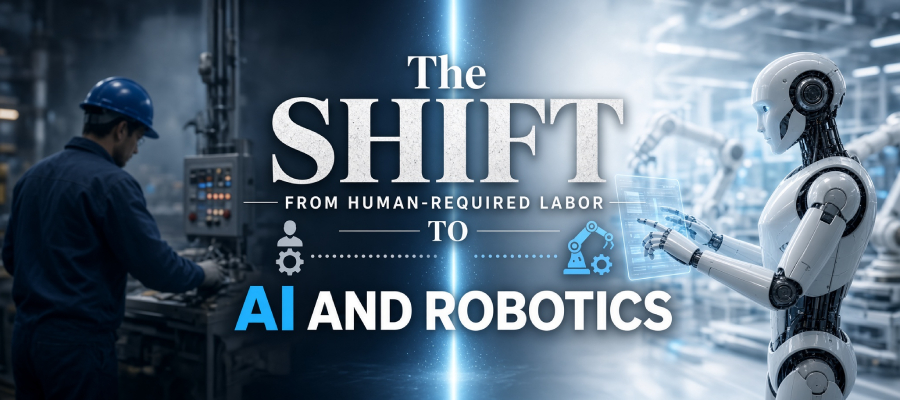
Either way, it appears that the change is upon us, and it is a big one. We are watching a fundamental shift in how the world does business. The shift from human-required labor to AI and robotics is happening. The world on the other side of this shift will look completely different. And make no mistake, there will be significant struggles along the way. Just know that there is light on the other side. Think of it like pre- versus post-Civil War, or pre- versus post-World War II. Before and after were completely different. We are underway.
References
Acemoglu, D., & Restrepo, P. (2020). Robots and jobs: Evidence from US labor markets. Journal of Political Economy, 128(6), 2188–2244. https://doi.org/10.1086/705716
Brynjolfsson, E., Li, D., & Raymond, L. (2025). Generative AI at work. The Quarterly Journal of Economics, 140(2), 889–942. https://doi.org/10.1093/qje/qjae044