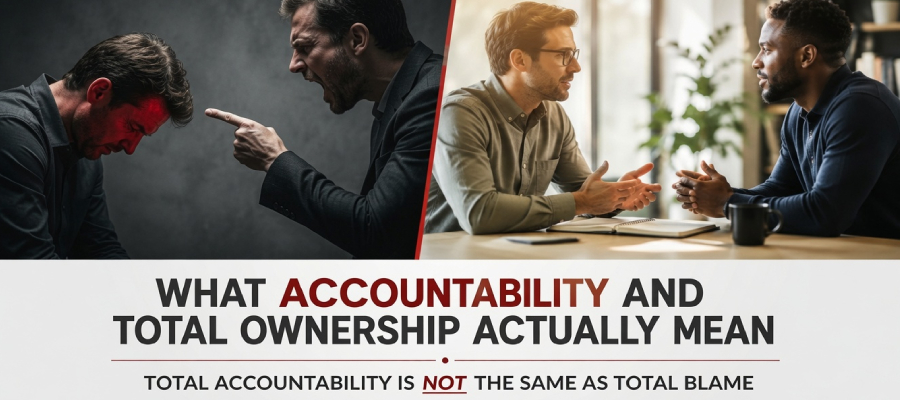
I’m sure we’ve all heard the phrase “take full accountability.” And I’m sure we’ve all seen it used as a weapon rather than a standard. In my line of work, I often see someone own their mistake honestly, name what they did, explain the effect it had, and commit to doing better. Then, out of nowhere, someone else in the room decides that honesty is an opening, and the conversation shifts from what actually happened to how much more this person can be made to absorb. Think of celebrities trying to apologize for something they did two decades ago, and the media steps it up to try and destroy them.
We see this in relationships, organizations, and teams. The accountable party did the hard thing, and the room punishes them for it by demanding they also carry a portion of the incident that was never theirs to carry. It persists because two entirely different concepts are treated as though they were one. Accountability and blame are not synonyms. They are not even measuring the same thing. Understanding the difference between them, and holding that difference firmly under pressure, is probably one of the more consequential skills a leader can develop. I’ll explain.
Two Different Axes
Let’s start with the elephant in the room. Accountability is about ownership of one’s own contribution. It measures whether a party can accurately identify what they did, why they did it, what effect it produced, and what they would do differently. Full accountability on this axis means that ownership is complete for the party’s own actions. Nothing hedged. Nothing minimized. Nothing quietly offloaded onto circumstance or onto someone else’s behavior. However, this axis has (and should have) a ceiling: the party’s actual causal contribution to the incident. This is to say that a person cannot be more than fully accountable for what they did, because the axis simply stops at the edge of their own actions.
The problem begins when someone wants to offload blame onto the person being held accountable. However, blame is a different measurement entirely. It concerns causal attribution across the whole incident, not the ownership behavior of any single party.
This is important to understand because in a two-party breakdown, blame is supposed to be properly distributed according to each party’s actual causal contribution to what occurred. This axis belongs to the incident as a whole, not to any one person’s willingness to talk about it.
For example, if Party A contributed 40% of the causal chain and takes full ownership of that 40%, that is not partial accountability that needs to be pushed further. It’s complete accountability for what was actually theirs. Hence, insisting that Party A also absorb Party B’s 60% doesn’t make the accountability more total. Instead, it renders the account inaccurate and turns what should be a diagnostic process into something closer to a scapegoating exercise.
Where the Confusion Originates
People tend to collapse these two axes because accountability feels like a moral virtue while blame feels like a factual assessment, and once someone starts behaving virtuously, there is a pull to assume they must also be the one most at fault. But that’s not reality. That pull is an emotional heuristic, and unfortunately, it’s a heuristic that often gets exploited, sometimes without full awareness on the part of the person doing the exploiting, by whichever party stands to benefit from the other absorbing more responsibility than they actually caused.
And this is where the distinction becomes genuinely consequential for leaders managing conflict between team members, business partners, or even within a marriage or a family system. The party that owns its share cleanly and accurately is frequently the party best positioned to be pushed further. And this is precisely because they have already demonstrated that they will not flinch from ownership.
What happens next is predictable. The party that deflects, minimizes, or refuses to engage honestly often escapes that same pressure because there’s nothing to hold on to. Ironically, the incentive structure that emerges from conflating accountability with blame rewards evasion and punishes honesty, which is the exact opposite of what any functional conflict resolution process should produce. Reasoned Leaders need to be acutely aware of this dynamic.
A Working Test
Thankfully, there’s a simple test that separates the two axes in real time, and it’s worth teaching to anyone in a leadership or mediating role. Simply ask whether the party is being asked to describe what they did, or whether they are being asked to describe the incident as though they were the only actor present in it. The first is accountability. The second is a demand dressed up as accountability, and it should be named as such the moment it appears.
A party who says “here is what I did, here is the effect it had, and here is how the other party’s actions fed into what followed” is not deflecting. That’s actually an analysis. Explaining a causal chain, including another party’s role within it, is not the same act as evading responsibility for one’s own role within it.
Confusing these two produces a specific and predictable failure mode, in which any mention of another party’s contribution is treated as an attempt to dodge, even when the account is accurate and even when the person offering it has already taken complete ownership of their own portion. Refusing to describe the full causal chain out of fear that it will look self-serving doesn’t produce a more honest account. If anything, it produces a distorted one, and a distorted account protects feelings for a short while at the direct expense of preventing the incident from happening again.
What This Means in Practice
The shorthand version, useful for anyone managing this kind of conflict directly, is that accountability is complete when it matches what a person actually did. Blame is accurate when it matches what actually happened across the full incident. However, neither axis grows by absorbing the other party’s share. A leader who understands this distinction can hold both halves of a conflict at once: full respect for a party’s honest ownership of their contribution, and an equally clear-eyed accounting of what the other party contributed, without treating the second as a betrayal of the first.
Of course, this matters beyond conflict resolution in the narrow sense. We need to understand that organizations and relationships that conflate accountability with blame literally train their most honest members to stop being honest, because honesty becomes the mechanism by which they get loaded with responsibility that was never theirs. Clearly, that’s not a good outcome.
Over time, that dynamic produces exactly the outcome no one wants: a culture where the people most capable of accurate self-assessment learn to stop offering it, and where the actual mechanics of what went wrong get buried under everyone’s incentive to avoid looking like the one who takes it all on. Naming the difference between these two axes, clearly and early, is what keeps accountability functioning as the virtue it is meant to be rather than the trap it so easily becomes.
Act accordingly.
Did you enjoy this article? Be sure to share it. Also, check out: The Secret to a Thriving Organizational Culture