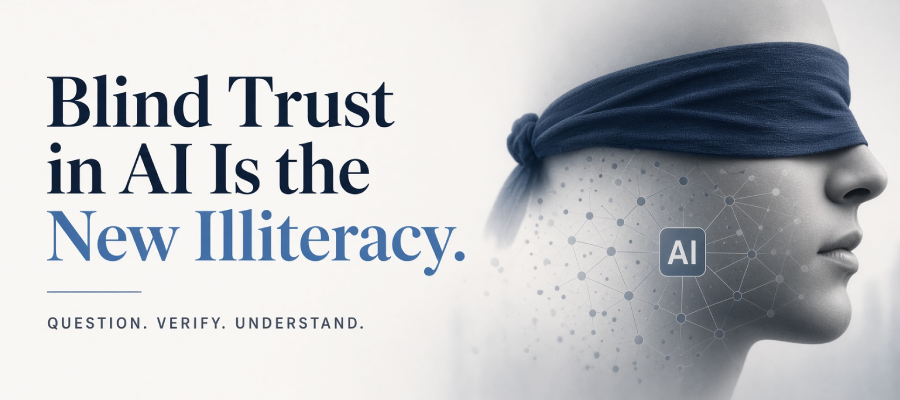
Blind trust in AI is the new illiteracy, and it can undermine leaders before they realize the damage has started. Leadership has always required the ability to distinguish between what appears true and what is actually true. That responsibility has not changed in this age of AI. What has changed is the speed and polish with which incomplete information now reaches us. Artificial intelligence has produced a significant cultural shift. Some of it is useful. Much of it isn’t. People who would never trust a stranger now trust an output simply because it carries the authority of a machine. The problem isn’t that AI gets everything wrong. The problem is that most people lack the knowledge required to recognize when it does. For leaders, this gap is no longer just a personal risk. It is an operational one.
Everyone needs to understand that AI reflects the information it can access. When the data is incomplete, the answer is incomplete. Yet the delivery remains confident and polished. This creates a powerful illusion of correctness that misleads anyone who hasn’t developed the ability to evaluate the output independently.
The situation that prompted this article is instructive. I asked a clarification question about leadership that required both public data and practical insight. The AI responded with a clear statistical explanation that tracked with official sources but entirely omitted the operational realities that professionals in the field already know. The output appeared credible. However, the omissions changed the entire interpretation of the issue. The problem is that someone without the relevant background would never have noticed the gap. Well, that gap was decisive.
I saw the same failure mode play out again with crime statistics. I once posed a complicated question to ChatGPT that relied entirely on public data. Anyone trained in security management, asset protection, or organized retail crime knows that the operational reality differs sharply from public-facing statistics. Public data captures only what is documented. Ground truth includes everything that isn’t. These are two different pictures of the same issue, and they can’t be treated as equivalent. The model conveyed only the public data without the known nuance. Only when I forced the distinction did the output change.
This is why I believe that blind trust in AI is the new illiteracy. When a person can’t recognize a tool’s boundaries in the face of their own limitations, they become dependent on it in ways that compromise judgment. They assume the answer is correct because it sounds about right, not because it withstands scrutiny. In an age where information spreads instantly, this dependency is dangerous. We’re seeing it accelerate in health, security, and leadership.
AI presents one slice of knowledge, shaped by public data, limited sources, and its training structure. It can deliver answers that seem complete while omitting the factors that actually determine the truth. Most users evaluate the answer by how it sounds rather than by what it contains. In ordinary conversation, people constantly read tone of voice, facial expression, and body language to decide whether someone is credible. AI has none of those. All that remains is the polished confidence of the text itself. So, when the output sounds assured, many readers treat that confidence as proof of accuracy. Omissions then go unexamined because the assumption is simple: if something important were missing, the AI would have mentioned it.
A useful parallel appears in how people report their own eating habits. Survey data often suggest that most Americans eat healthy meals, avoid junk food, and are the health model to follow. Indeed, the population appears far healthier on paper than it is in daily life. But that’s because most people don’t know what “healthy” is. If you have misconceptions about what health looks like, and then you self-report your health status, it likely won’t be accurate. I would argue that hard data on obesity rates, food purchases, and health outcomes repeatedly contradict self-reported narratives. The numbers look credible until you compare them to the actual conditions. The gap between the two exposes how easily an incomplete dataset distorts the overall picture, but understanding that gap requires background and experience.
This is why Contrastive Inquiry matters, especially when dealing with AI. Contrastive Inquiry forces the thinker to ask: What is the direct opposite of this claim, and what does that reveal? It requires the user to test assumptions, examine contrasts, and identify what’s missing. Applied to AI, the method determines whether the output offers a comprehensive explanation or merely a single viewpoint constrained by available data.
Sure, it takes some effort, but without contrast, the answer only appears whole. With contrast, the limitations become obvious. This skill doesn’t emerge from software. It emerges from competence, training, and the willingness to challenge what seems authoritative. AI can generate explanations. However, it’s far less effective at generating discernment. That responsibility falls on the user.
Think of it this way. A calculator is a powerful tool, but it doesn’t teach mathematics. It produces a correct answer only when the person using it understands enough to estimate what the result should look like. When a calculator produces an error, only someone with actual mathematical knowledge notices. AI is no different. If you can’t identify when an output is flawed, the tool becomes a liability rather than an advantage.
Competence therefore remains essential. Actually knowing stuff matters. AI amplifies the strengths of people who know what they’re doing. It also amplifies the errors of those who don’t. The tool doesn’t eliminate the need to learn or understand. If anything, it increases that need. I firmly believe that the more powerful the tool, the more dangerous it becomes in the hands of someone who can’t evaluate its results.
AI isn’t meant to replace thinking, but that’s what some people are using it for. It isn’t a substitute for experience, foundational knowledge, or disciplined reasoning. It’s a tool that requires an informed operator. Without that operator, it can become a source of misplaced confidence that misguides the user and distorts perception.
Now, the solution isn’t to avoid AI. The solution is to approach it with the same intellectual discipline required by any other serious tool. Learn the subject. Understand the field. Develop the capacity to challenge the information you receive. Apply Contrastive Inquiry to every important output. Then allow AI to accelerate understanding rather than replace it.
Indeed, blind trust in AI is the new illiteracy because it creates the illusion of knowledge without the substance required to support it. Don’t fall for it. Don’t become a victim of that illusion. Real literacy in this new modern world requires the ability to evaluate, verify, challenge, and think. AI can support the process, but it can’t perform it for you.
Did you get something out of this article? You might also like AI Monitoring Increases Organizational Blindness